

Overview
Regenerative braking cleverly converts a vehicle’s kinetic energy back into electricity during deceleration—essentially giving you free energy every time you slow down instead of wasting it as heat. Beyond extending driving range by up to 25%, this technology delivers significant financial benefits through reduced electricity costs and less frequent brake maintenance, potentially saving owners thousands of dollars over their vehicle’s lifetime while contributing to environmental sustainability.
Table of Contents
- What Is Regenerative Braking?
- How Regenerative Braking Works
- Benefits of Regenerative Braking
- Cash Savings with Regenerative Braking
- Avoiding Breakdowns with Regenerative Braking
- Types of Regenerative Braking Systems
- Maximizing Regenerative Braking Efficiency
- Common Misconceptions About Regenerative Braking
- Conclusion
- Frequently Asked Questions
What Is Regenerative Braking?
Regenerative braking is one of those automotive technologies that sounds complicated but is actually quite brilliant in its simplicity. As a mechanic who’s worked on everything from classic gasoline engines to cutting-edge electric vehicles, I can tell you that regenerative braking represents one of the most significant advancements in vehicle efficiency in the past few decades.
At its core, what is regenerative braking? It’s a system that captures the energy normally lost during braking and converts it back into electricity to recharge your vehicle’s battery. Think about it—in a conventional car, when you press the brake pedal, your brake pads squeeze against the rotors, creating friction that slows your vehicle. All that kinetic energy (the energy of motion) gets converted to heat and literally disappears into thin air.
But regenerative braking systems are smarter than that. They use the electric motor in hybrid or electric vehicles in reverse, turning it into a generator that captures that would-be-wasted energy. It’s like turning your car into a mobile power plant every time you slow down!
This technology is found in virtually all hybrid and electric vehicles today, from the Toyota Prius to the Tesla Model 3 and even in some newer conventional vehicles with mild hybrid systems. The beauty of regenerative braking is in how it elegantly solves two problems at once: it helps slow the vehicle down while simultaneously recovering energy that would otherwise be lost.
How Regenerative Braking Works
Let’s break down how regenerative braking works without getting too technical. When your car is moving, it has kinetic energy. In a traditional car with regular brakes, when you step on the brake pedal, the brake pads create friction against the rotors or drums, and all that kinetic energy converts to heat—which literally just floats away into the atmosphere.
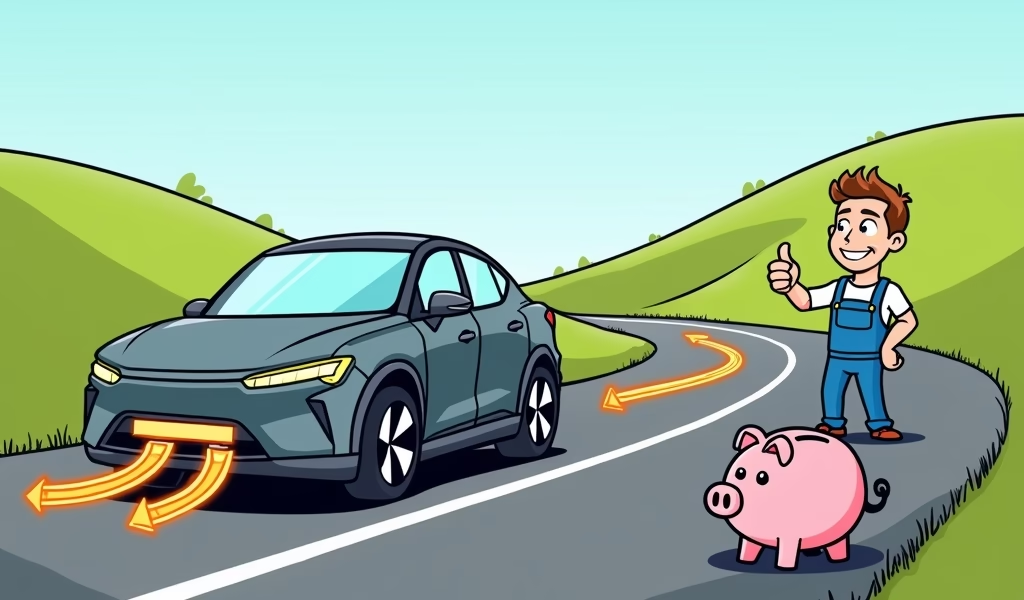
In a vehicle with regenerative braking technology, something much more clever happens. When you release the accelerator or press the brake, the electric motor that normally propels the car forward switches into generator mode. The wheels, still turning from the car’s momentum, now turn this generator instead of just rubbing against brake pads.
As the generator spins, it creates electrical resistance—which is what slows the car down—while simultaneously producing electricity that gets fed back into the battery. It’s essentially converting your car’s momentum back into stored electrical energy. The more aggressively you brake, the more energy gets regenerated.
Most modern systems are sophisticated enough to blend regenerative and traditional friction braking seamlessly. At lower speeds, when regenerative braking becomes less effective, or during emergency stops requiring maximum braking force, the conventional friction brakes automatically take over. This happens so smoothly you’d never notice the transition as a driver.
Benefits of Regenerative Braking
Regenerative braking isn’t just a cool tech feature—it delivers tangible benefits that improve your driving experience and your wallet’s health. After working on hundreds of hybrid and electric vehicles, I’ve seen firsthand how these systems create multiple advantages.
The most obvious benefit is improved fuel efficiency and extended range. By recapturing energy that would otherwise be lost, regenerative braking can increase the overall efficiency of an electric vehicle by 10-25%, according to studies from the U.S. Department of Energy. This means fewer stops at the charging station or gas pump.
Beyond efficiency, there’s the reduced brake wear. Since your conventional brakes are used less frequently, brake pads and rotors last significantly longer. I’ve worked on EVs with over 70,000 miles that still had most of their original brake pad material—something unheard of in conventional vehicles.
There’s also the environmental impact. Less energy consumption means fewer emissions for hybrids and even for EVs, since the electricity they use often comes from a mix of renewable and fossil fuel sources. More efficient vehicles mean a smaller carbon footprint.
Finally, there’s the driving experience itself. Many drivers, once they get used to it, prefer the smooth, controlled deceleration of regenerative braking. In heavy traffic, some systems are robust enough that you can almost drive with just one pedal, using the accelerator to speed up and releasing it to slow down.
Cash Savings with Regenerative Braking
Let’s talk dollars and cents, because that’s where regenerative braking really shines. As someone who’s tracked maintenance costs across different vehicle types, I can confidently say this technology saves you money in multiple ways.
First, there’s the direct fuel or electricity savings. By recapturing energy during braking, vehicles with regenerative systems can extend their range by up to 25% compared to equivalent vehicles without this technology. For a typical EV owner driving 12,000 miles per year, this could translate to savings of $200-400 annually on electricity costs.
The reduction in brake wear is where you’ll see some of the most tangible maintenance savings. Traditional brake jobs can cost anywhere from $250 to $700 depending on your vehicle. With regenerative braking, many drivers report needing brake service only half as often—or even less. I’ve seen hybrid and electric vehicles go 100,000+ miles on their original brake pads, potentially saving $1,000+ over the lifetime of the vehicle.
Here’s a quick breakdown of potential savings:
- Reduced fuel/electricity costs: $200-400 per year
- Extended brake life: $500-1,500 over vehicle lifetime
- Fewer brake fluid changes: $100-200 over vehicle lifetime
- Potential tax incentives for efficient vehicles: Varies by location
These savings add up significantly over the life of your vehicle. In many cases, the regenerative braking system effectively pays for itself through these accumulated savings—one reason why manufacturers have embraced this technology so enthusiastically.
Avoiding Breakdowns with Regenerative Braking
One aspect of regenerative braking that doesn’t get enough attention is how it can help prevent breakdowns and extend the overall lifespan of your vehicle. As someone who’s had to rescue stranded drivers for years, I appreciate any technology that keeps cars running reliably.
The primary way regenerative braking prevents breakdowns is by reducing stress on your conventional braking system. When your standard brakes operate less frequently and with less intensity, there’s reduced risk of overheating, warping, or premature wear. This means fewer brake-related emergencies, which account for a surprising number of roadside assistance calls.
For electric vehicles, the regenerative system also helps maintain battery health. By providing a steadier, more controlled form of charging rather than relying solely on plugging in, these systems can contribute to more balanced battery usage patterns. The battery management systems in modern EVs are sophisticated, but regenerative braking gives them more options for optimizing battery longevity.
In hybrid vehicles, the regenerative system reduces strain on the internal combustion engine by allowing the electric motor to handle more of the work. This means less wear on engine components, potentially extending engine life and reducing the chance of engine-related breakdowns.

Types of Regenerative Braking Systems
Not all regenerative braking systems are created equal. Through my years working in shops specializing in hybrid and electric vehicles, I’ve encountered several distinct types, each with their own characteristics and benefits.
Series regenerative braking systems are what you’ll find in fully electric vehicles like Teslas. In these systems, the electric motor handles nearly all braking during normal driving conditions. The conventional friction brakes only activate during emergency stops or when the battery is already fully charged. These systems typically offer the highest energy recovery rates—up to 70% of braking energy can be recaptured in ideal conditions.
Parallel regenerative systems are common in hybrid vehicles like the Toyota Prius. These work alongside the conventional braking system, with the vehicle’s computer determining the optimal balance between regenerative and friction braking based on driving conditions. While they typically recover less energy than series systems (usually 30-50%), they provide a more familiar braking feel for drivers transitioning from conventional vehicles.
Adjustable regenerative braking is becoming increasingly popular, allowing drivers to select different levels of regenerative braking force. For example, many newer EVs offer settings ranging from light regeneration (feeling more like a conventional car when you release the accelerator) to aggressive “one-pedal driving” where simply lifting off the accelerator provides strong deceleration. This customization helps drivers maximize efficiency based on their driving style and preferences.
Hydraulic regenerative braking is less common but used in some specialized applications. Rather than generating electricity, these systems store braking energy as pressurized fluid, which can later assist with acceleration. UPS has tested these systems in their delivery trucks with promising results.
Maximizing Regenerative Braking Efficiency
After helping countless drivers get the most from their hybrid and electric vehicles, I’ve gathered some practical tips to maximize the benefits of regenerative braking. These simple adjustments to your driving habits can significantly boost your vehicle’s efficiency.
First, master the art of anticipation. Look far ahead while driving and anticipate when you’ll need to slow down. This allows you to use regenerative braking more effectively instead of relying on sudden, hard braking where the friction brakes will dominate. The smoothest, most gradual deceleration typically captures the most energy.
If your vehicle has adjustable regenerative braking settings, experiment to find what works best for different driving scenarios. Many drivers use stronger regeneration in stop-and-go city driving and lighter settings on highways. Some vehicles even allow you to set up profiles for different drivers or conditions.
Be mindful of your battery state. Regenerative braking is most effective when your battery has room to accept a charge. If your EV is already at 100% charge (such as when starting a downhill journey after charging), the system may default more to conventional brakes since the battery can’t accept more energy.
Consider these practical tips to maximize efficiency:
- Use “one-pedal driving” techniques in city traffic when available
- Remove unnecessary weight from your vehicle to reduce braking requirements
- Maintain proper tire inflation for optimal energy transfer
- In cold weather, allow your vehicle to warm up for maximum regenerative capacity
- Use eco-driving modes which often optimize regenerative braking settings
By implementing these strategies, many drivers report gaining an additional 5-10% range from their vehicles—a significant improvement that costs nothing but a small adjustment to driving habits.
Common Misconceptions About Regenerative Braking
Over my years explaining regenerative braking to customers, I’ve encountered numerous misconceptions that deserve clearing up. Understanding what this technology actually does—and doesn’t do—helps you make better decisions about your vehicle.
Perhaps the most common myth is that regenerative braking means your conventional brakes don’t work or aren’t necessary. This isn’t true—all vehicles with regenerative braking also have traditional friction brakes as backup. The regenerative system handles most normal deceleration, but your hydraulic brakes are still essential for emergency stops and for when the battery is too full to accept regenerated energy.
Another misconception is that regenerative braking creates energy out of nothing, somehow violating physics. What it actually does is recapture energy you’ve already used to accelerate the vehicle—energy that would otherwise be wasted as heat. It’s recovery, not creation, following the laws of thermodynamics perfectly.
Some drivers worry that regenerative braking is hard on the battery or will shorten battery life. According to research from the National Renewable Energy Laboratory, modern battery management systems are designed to handle the charging patterns from regenerative braking. In fact, the gentle, intermittent charging from regeneration is often less stressful than fast-charging.
Finally, there’s a belief that regenerative braking means you never need to service your brakes. While brake pad life is dramatically extended, you should still have your entire braking system inspected regularly. Brake fluid still ages, calipers can still seize, and other components still require maintenance—albeit less frequently.
Conclusion
Regenerative braking represents one of the most elegant and practical innovations in modern vehicles. It transforms what was once wasted energy into a valuable resource, extending your vehicle’s range while reducing wear on traditional braking components. The technology essentially gives you free energy every time you slow down—energy you’ve already paid for once through your initial acceleration.
As we’ve explored, the benefits extend well beyond just energy efficiency. The financial savings from reduced fuel or electricity consumption, combined with lower maintenance costs for brake components, can add up to thousands of dollars over the life of your vehicle. Meanwhile, the reduced stress on your conventional braking system helps prevent breakdowns and enhances overall reliability.
Whether you currently drive a vehicle with regenerative braking or are considering one for your next purchase, understanding how to maximize this technology’s potential gives you an edge in efficiency and cost savings. By adopting driving habits that favor regenerative over friction braking and keeping your system properly maintained, you’ll enjoy the full spectrum of benefits this technology offers.
The future of regenerative braking looks promising, with continuous improvements making these systems more efficient and user-friendly. As battery technology advances and regenerative systems become even more sophisticated, we can expect to see even greater energy recovery rates and more intuitive driver interfaces.
In the end, regenerative braking isn’t just smart technology—it’s smart economics and smart environmental stewardship, all rolled into one seamless system that works quietly in the background every time you ease off the accelerator.
Frequently Asked Questions
Does regenerative braking work when the battery is fully charged?
No, regenerative braking is limited or disabled when the battery is fully charged since there’s nowhere to store the recaptured energy. The vehicle will automatically switch to conventional brakes in this situation.
Can regenerative braking completely replace conventional brakes?
No, conventional friction brakes are still necessary for emergency stops and situations when regenerative braking is insufficient. All vehicles with regenerative braking also have traditional braking systems.
Does regenerative braking work in very cold weather?
Regenerative braking effectiveness is reduced in very cold weather due to battery chemistry limitations. Most vehicles automatically adjust the system based on temperature conditions.
How much energy does regenerative braking actually recover?
Depending on the system and driving conditions, regenerative braking typically recovers between 30% and 70% of the energy used during deceleration. Urban driving with frequent stops yields the highest recovery rates.
Will I feel a difference when driving with regenerative braking?
Yes, many drivers notice a different feel when lifting off the accelerator as the regenerative braking creates deceleration. Most modern vehicles allow you to adjust the strength of this effect to match your preferences.