
Overview
Like discovering a $5,000 repair bill after your transmission fails, many Volkswagen Arteon owners learn too late that proper maintenance could have prevented disaster. This comprehensive guide details the specific care required for both the 8-speed automatic and DSG transmissions, covering warning signs, maintenance schedules, and cost-effective service options to protect your sophisticated German sedan for 150,000+ miles.
Table of Contents
- The $5,000 Problem You Can Prevent
- What Makes the Volkswagen Arteon Transmission Special
- Why Your Arteon’s Transmission Matters
- Warning Signs of Arteon Transmission Problems
- Common Causes of VW Arteon Transmission Failures
- Expected Lifespan of Volkswagen Arteon Transmissions
- Essential Maintenance Schedule for Arteon Transmissions
- When Replacement Becomes Necessary
- Cost Expectations: Budgeting for Transmission Care
- DIY vs. Professional Service
- Common Mistakes Arteon Owners Make
- Protecting Your Investment
- Frequently Asked Questions
The $5,000 Problem You Can Prevent
Picture this: you’re cruising in your Volkswagen Arteon, enjoying that perfect balance of luxury and performance when suddenly, your car jerks, the RPMs spike, but you barely move forward. That’s exactly what happened to Michael just after celebrating two years with his Arteon. The diagnosis? Complete transmission failure. The repair bill? A jaw-dropping $5,200.
This isn’t just Michael’s bad luck – it’s a scenario that plays out for many Arteon owners who overlook proper transmission care. The sophisticated engineering that makes your Arteon such a joy to drive also makes its transmission particularly vulnerable when maintenance takes a backseat.
Here’s the good news: most of these expensive transmission disasters are completely preventable. With proper knowledge and a solid maintenance routine, you can protect your investment and enjoy that refined Arteon driving experience for many years to come. Let’s dive into how you can save yourself from that dreaded $5,000+ repair bill.
What Makes the Volkswagen Arteon Transmission Special
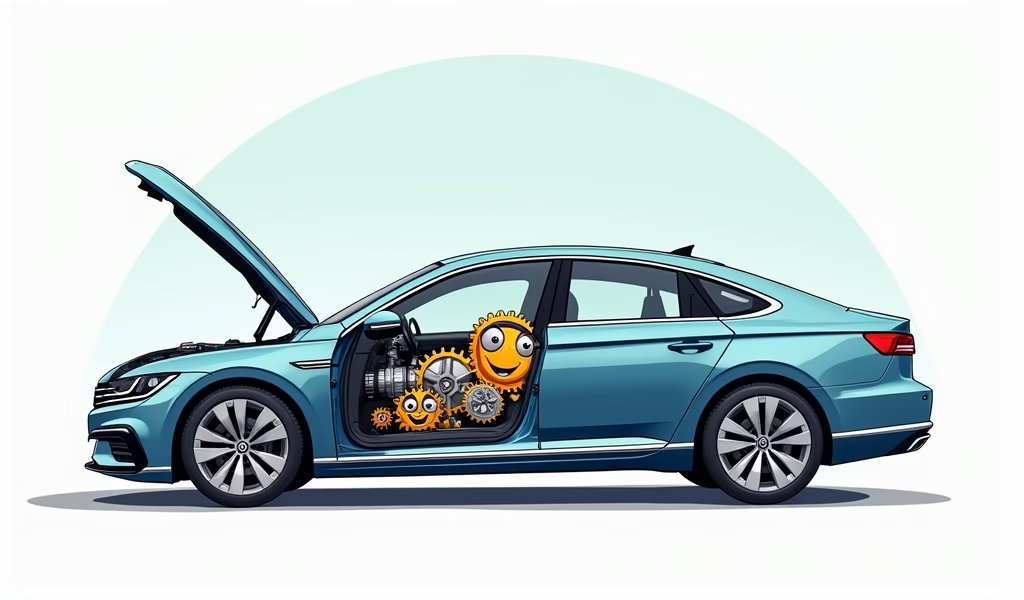
The Volkswagen Arteon comes equipped with one of two transmission options, each bringing its own unique characteristics to your driving experience. Most U.S. models feature VW’s refined 8-speed automatic transmission, while some markets offer the celebrated 7-speed DSG (Direct-Shift Gearbox) dual-clutch transmission.
The 8-speed automatic is a marvel of modern engineering. It delivers silky smooth, nearly imperceptible shifts while maximizing fuel efficiency across various driving conditions. With multiple overdrive gears, it keeps your engine RPMs low during highway cruising, helping achieve impressive fuel economy despite the Arteon’s powerful engine.
For those lucky enough to have the DSG transmission, you’re experiencing something truly special. Unlike conventional automatics with torque converters, the DSG employs two separate clutches – one handling odd-numbered gears and one for even-numbered gears. This clever design pre-selects the next gear before you need it, resulting in lightning-fast shift times under 8 milliseconds – quicker than any human could achieve with a manual.
What truly sets the Arteon’s transmission apart from those in other Volkswagen models is its calibration for near-luxury performance. Engineers have fine-tuned the shifting algorithms to prioritize smoothness and refinement while maintaining responsive performance. The transmission control unit constantly analyzes data from throughout the vehicle, adjusting shift patterns based on your driving style, road conditions, and even the car’s cornering forces.
This sophisticated automatic transmission technology delivers exceptional performance but demands specialized care. The complex mechatronics unit controlling the DSG is particularly sensitive to fluid quality and operating temperature, while the 8-speed relies on precise hydraulic pressure management that can be compromised by degraded transmission fluid.
Why Your Arteon’s Transmission Matters
Your Arteon’s transmission isn’t just the mechanism that changes gears – it’s the heart of your driving experience. A properly functioning transmission delivers power smoothly and precisely, maximizing both performance and efficiency. When shifting feels instantaneous and effortless, it reinforces that premium experience you invested in when choosing the Arteon.
From a practical standpoint, transmission health directly impacts your fuel economy. A well-maintained transmission operates at peak efficiency, while one with developing issues forces your engine to work harder, burning more fuel. For Arteon owners, this difference can add up to hundreds of dollars annually at the pump.
Perhaps most compelling is the impact on resale value. Luxury vehicle buyers scrutinize maintenance records carefully, and documented transmission care signals that a vehicle has been properly maintained. When service records show regular transmission maintenance, potential buyers gain confidence – often translating to thousands more in resale value.
Moreover, transmission reliability influences your overall satisfaction with the vehicle. Nothing diminishes the pleasure of driving your sophisticated German sedan quite like wondering if it will shift properly during your morning commute. That peace of mind is a luxury worth investing in.
Warning Signs of Arteon Transmission Problems
Catching transmission issues early can mean the difference between a minor repair and a complete replacement. Here are the warning signs specific to the Volkswagen Arteon that demand immediate attention:
Delayed or Rough Shifting: If your Arteon hesitates before engaging a gear, especially from Park to Drive, or if you experience harsh, jolting transitions between gears, your transmission is sending distress signals. The Arteon should deliver almost imperceptible shifts under normal driving conditions.
Unusual Noises: Pay attention to sounds that coincide with shifting. A high-pitched whine during acceleration, a buzzing sound while in gear, or a clunking noise when shifting into Drive or Reverse indicates potential trouble. The DSG transmission may normally produce a slight mechanical sound during low-speed operation, but any grinding or rattling is abnormal.
Slipping Gears: If you notice your engine revving higher without a corresponding increase in speed, your transmission may be slipping. Similarly, if your Arteon unexpectedly downshifts when maintaining constant speed, the transmission control unit may be compensating for internal pressure problems.
Transmission Fluid Issues: Check for reddish fluid beneath your parked vehicle. Unlike engine oil leaks, transmission fluid leaks often appear toward the middle of the car. Additionally, if you detect a burning smell after driving, the transmission fluid may be overheating.
Dashboard Warning Indicators: The Arteon’s sophisticated computer systems monitor transmission performance constantly. A flashing gear position indicator, a transmission temperature warning, or a “transmission malfunction” message all require immediate professional attention. In some cases, the vehicle may enter “limp mode,” severely limiting performance to protect the transmission from further damage.
According to Car and Driver research, addressing these warning signs early can prevent catastrophic failures that often result in complete transmission replacement.
Common Causes of VW Arteon Transmission Failures
Understanding what causes Arteon transmission failures helps you avoid these pitfalls:
Fluid Issues: The most common cause of premature transmission failure is inadequate fluid maintenance. Both the 8-speed automatic and DSG transmissions require specific fluid types meeting Volkswagen’s stringent specifications. Using incorrect fluid, failing to change fluid at recommended intervals, or insufficient fluid levels can lead to overheating, inadequate lubrication, and eventual component failure.
DSG-Specific Maintenance Neglect: Arteons with DSG transmissions have additional maintenance requirements. The DSG contains an internal filter and requires periodic fluid changes typically every 40,000 miles. Skipping these services leads to contaminated fluid circulating through precision components, accelerating wear.
Electronic Control Problems: The Arteon’s transmissions rely on sophisticated electronic controls. Software glitches, sensor failures, or wiring issues can cause erratic shifting, false warning lights, or transmission confusion. These electronic problems often manifest intermittently, making diagnosis challenging.
Overheating: Transmission fluid breaks down more quickly under extreme conditions. Stop-and-go traffic, mountain driving, or aggressive driving patterns increase operating temperatures. Without proper cooling, internal components can warp, seals can fail, and friction materials deteriorate prematurely.
Manufacturing Variations: Some model years have shown higher rates of specific transmission issues. Early production 2019 models occasionally experienced mechatronic unit issues in the DSG transmission, while some 2020 models had reports of torque converter shudder in the 8-speed automatic.
Expected Lifespan of Volkswagen Arteon Transmissions
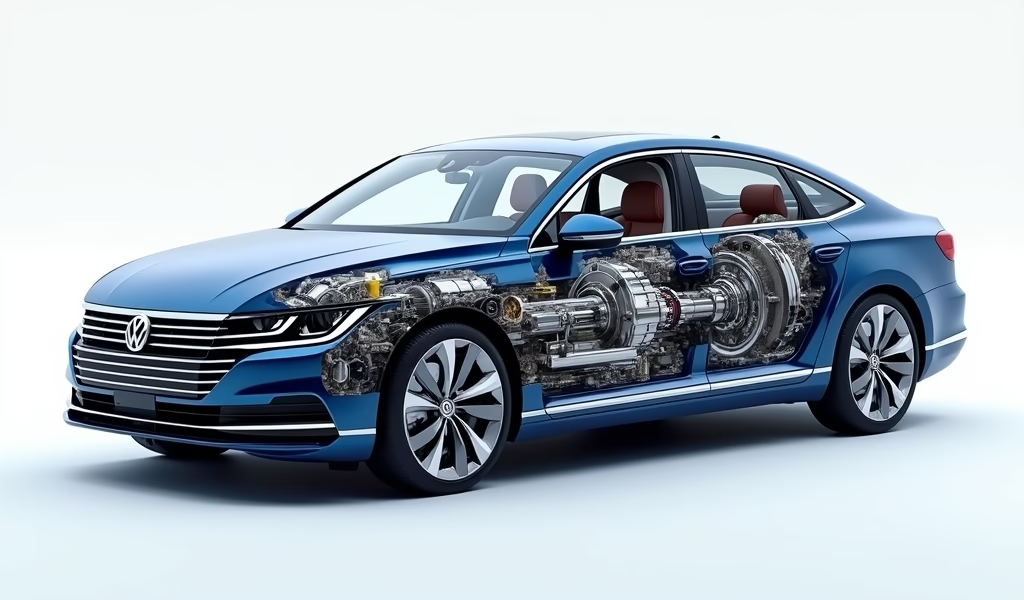
With proper maintenance, your Arteon’s transmission should deliver reliable service well beyond 100,000 miles. Many owners report reaching 150,000 to 200,000 miles without major transmission issues when following manufacturer recommendations diligently.
Several factors influence this longevity. Transmission fluid change intervals make perhaps the most significant difference – owners who change transmission fluid more frequently than the minimum recommendations often see extended transmission life. The driving environment also plays a crucial role; vehicles primarily used for highway driving typically experience less transmission wear than those subjected to constant stop-and-go urban conditions.
Your driving habits directly impact transmission lifespan as well. Gentle acceleration, allowing the transmission to fully engage before accelerating hard, and avoiding prolonged “creeping” in traffic all reduce strain on transmission components. The transmission control unit actually learns your driving style over time, so consistent, smooth driving helps optimize shift patterns.
Compared to competitors in the luxury segment, the Arteon’s transmissions perform admirably. The 8-speed automatic generally matches the reliability of similar units found in Audi and BMW vehicles, while requiring less costly maintenance than some luxury counterparts. The DSG, when properly maintained, has demonstrated excellent longevity compared to other dual-clutch transmissions in its class.
A study by Consumer Reports suggests that following manufacturer-recommended maintenance can extend transmission life by up to 50% compared to vehicles with neglected service schedules.
Essential Maintenance Schedule for Arteon Transmissions
Following a structured maintenance schedule dramatically reduces your risk of transmission problems:
Manufacturer-Recommended Service Intervals
- For 8-speed automatic transmissions: Volkswagen recommends fluid changes every 60,000 miles under normal conditions, but every 30,000 miles for vehicles driven in severe conditions (extreme temperatures, mountainous terrain, or heavy traffic).
- For DSG transmissions: Fluid and filter changes are required every 40,000 miles, regardless of driving conditions.
DSG-Specific Maintenance
Beyond regular fluid changes, DSG transmissions benefit from periodic clutch adaptation procedures. This electronic calibration optimizes clutch engagement and can reduce the jerky low-speed operation some owners experience. Most dealers perform this adaptation during regular DSG service.
Transmission Fluid Change Protocols
The Arteon’s transmissions require specific procedures for fluid changes. Unlike some vehicles where you simply drain and refill, proper service requires specialized equipment to measure fluid temperature and level precisely. The correct filling procedure ensures the transmission contains exactly the right amount of fluid – too much can be just as damaging as too little.
Software Updates
Periodically check with your dealer for transmission control module updates. Volkswagen continuously refines the shifting algorithms to address customer feedback and improve reliability. These updates can resolve shifting harshness, hesitation, or other driveability concerns before they lead to component damage.
Preventative Inspections
Request transmission mount inspection during oil changes. Deteriorated mounts allow excessive movement, placing stress on transmission components and connections. Also, have the transmission cooler lines checked for leaks or damage, as compromised cooling accelerates fluid breakdown.
According to the American Automobile Association (AAA), regular transmission fluid changes are among the most overlooked but crucial maintenance items for vehicle longevity.
When Replacement Becomes Necessary
Despite your best maintenance efforts, there may come a point when transmission replacement becomes unavoidable. Several indicators suggest repair may no longer be sufficient:
When internal mechanical damage occurs (broken gear teeth, damaged valve bodies, or failed bearings), the repair costs often approach replacement costs. If your Arteon exhibits slipping that persists after fluid changes, makes grinding noises during shifts, or refuses to engage certain gears, internal damage is likely.
When evaluating repair versus replacement, consider your vehicle’s age and value. For Arteons less than five years old with lower mileage, investing in a factory remanufactured transmission often makes financial sense, as it restores the vehicle to like-new condition and preserves resale value. For older models, rebuilt aftermarket units may offer a more economical solution while still providing reliable service.
Warranty considerations play a crucial role in this decision. Volkswagen’s powertrain warranty covers the transmission for 4 years or 50,000 miles, whichever comes first. If your vehicle is approaching these limits and showing early signs of transmission trouble, addressing the issue before warranty expiration could save thousands.
For certified pre-owned Arteon purchasers, the extended warranty typically adds 2 years and 24,000 miles of coverage beyond the original powertrain warranty. This extended protection makes CPO vehicles particularly attractive for buyers concerned about potential transmission issues.
Cost Expectations: Budgeting for Transmission Care
Understanding the financial aspects of transmission maintenance helps you budget appropriately:
Routine Maintenance:
- DSG fluid and filter service: $350-$500 at dealerships, $250-$400 at independent Volkswagen specialists
- 8-speed automatic fluid change: $300-$450 at dealerships, $200-$350 at independent shops
- Transmission software updates: Often $150-$200 if not covered under warranty
Minor Repairs:
- Shift solenoid replacement: $400-$700
- External sensor replacement: $200-$450
- Transmission mount replacement: $300-$600
Major Repairs and Replacement:
- Mechatronic unit replacement (DSG): $1,800-$2,800
- Valve body replacement (8-speed automatic): $1,500-$2,200
- Complete transmission replacement: $4,500-$7,000 depending on source (factory remanufactured vs. rebuilt)
Insurance and Warranty Considerations:
Extended warranties often cover transmission repairs, but read the fine print – many require documentation of regular maintenance according to manufacturer schedules. Some third-party extended warranty providers offer specific powertrain coverage at more affordable rates than comprehensive warranties. For high-mileage Arteons, these focused policies can provide valuable protection against catastrophic transmission expenses.
DIY vs. Professional Service
While the Arteon’s sophisticated engineering limits DIY options, there are still maintenance tasks owners can perform:
Owner-Level Maintenance:
- Transmission fluid level checks (when equipped with a dipstick)
- Visual inspection for fluid leaks
- Monitoring transmission performance and documenting symptoms
- Basic scanner diagnostics using consumer-grade OBD-II tools
For these tasks, you’ll need basic hand tools, a flashlight, clean shop rags, and potentially an OBD-II scanner capable of reading transmission data. However, most transmission maintenance requires professional service.
Professional-Only Services:
- Fluid changes (both transmissions require precise filling procedures)
- Filter replacements (particularly for the DSG)
- Programming and adaptations
- Internal repairs of any kind
Finding qualified Volkswagen specialists matters enormously. Look for shops that invest in Volkswagen-specific diagnostic equipment and have technicians with factory training or certification. Independent European specialty shops often offer the ideal balance of expertise and value, typically charging 30-40% less than dealerships while maintaining comparable quality.
Common Mistakes Arteon Owners Make
Avoid these common pitfalls that lead to premature transmission problems:
Ignoring Warning Signs: Many owners dismiss initial transmission symptoms, hoping they’ll resolve themselves. Early intervention when you first notice unusual shifting behavior can prevent cascading damage that turns a minor issue into a complete failure.
Using Incorrect Fluids: The Arteon’s transmissions require specific fluids meeting Volkswagen’s technical specifications. Using generic transmission fluid, even if labeled for European vehicles, can cause shifting problems and accelerate wear. Always verify that replacement fluid meets the exact specification listed in your owner’s manual.
Neglecting DSG Maintenance: The DSG’s dual-clutch design offers performance advantages but demands strict adherence to maintenance schedules. The internal filter can’t be inspected visually, making regular replacement essential regardless of how the transmission seems to be performing.
DIY Overconfidence: Attempting transmission repairs beyond your skill level risks introducing new problems. Even seemingly simple tasks like fluid changes require specialized tools for the Arteon’s transmissions. Temperature-sensitive filling procedures and electronic adaptations make professional service particularly important.
False Economy: Choosing budget repair options often leads to repeated failures. Aftermarket parts not meeting OEM specifications may fit but frequently don’t perform to factory standards. Similarly, shops without Volkswagen-specific experience may miss critical calibration steps during repairs.
Protecting Your Investment
Your Volkswagen Arteon represents a significant investment in both luxury and performance. Its sophisticated transmission is central to the refined driving experience that makes the Arteon special. By following the manufacturer’s maintenance schedule, responding promptly to warning signs, and choosing qualified service providers, you can avoid the devastating expense and inconvenience of major transmission failures.
Remember that prevention costs a fraction of repair. Regular transmission fluid services might seem expensive at $300-$500 every few years, but they’re insignificant compared to a $5,000+ replacement. Documentation of this maintenance also enhances your vehicle’s resale value, often returning your investment multiple times over when it’s time to sell.
If you’re concerned about your Arteon’s transmission performance, start with a comprehensive diagnostic evaluation from a qualified Volkswagen specialist. Even if no immediate issues are found, establishing a relationship with a knowledgeable service provider gives you a trusted resource for future maintenance needs.
With proper care, your Arteon’s transmission can deliver reliable, smooth performance throughout your ownership experience, preserving both your investment and your driving pleasure for many miles to come.
Frequently Asked Questions
How often should I change my Volkswagen Arteon transmission fluid?
For 8-speed automatic transmissions, change fluid every 60,000 miles under normal conditions or every 30,000 miles for severe conditions. DSG transmissions require fluid and filter changes every 40,000 miles regardless of driving conditions.
What are the first signs of transmission problems in an Arteon?
Early warning signs include delayed engagement when shifting from Park to Drive, rough or jerky shifts between gears, and unusual noises during shifting. You might also notice the check engine light illuminating or transmission warning messages on your dashboard.
Can I tow with my Arteon?
Volkswagen does not recommend using the Arteon for towing in North American markets. The transmission cooling system isn’t designed for the additional heat generated during towing, which could lead to premature fluid breakdown.
What’s the average cost to replace an Arteon transmission?
Complete replacement costs typically range from $4,500 to $7,000, depending on whether you choose a factory remanufactured unit or a quality rebuilt transmission. This includes parts, labor, fluid, and programming.
Are VW Arteon transmissions covered under warranty?
The standard powertrain warranty covers most internal transmission components for 4 years or 50,000 miles. Certified pre-owned vehicles typically receive an additional 2 years and 24,000 miles of coverage beyond the original powertrain warranty.