
Overview
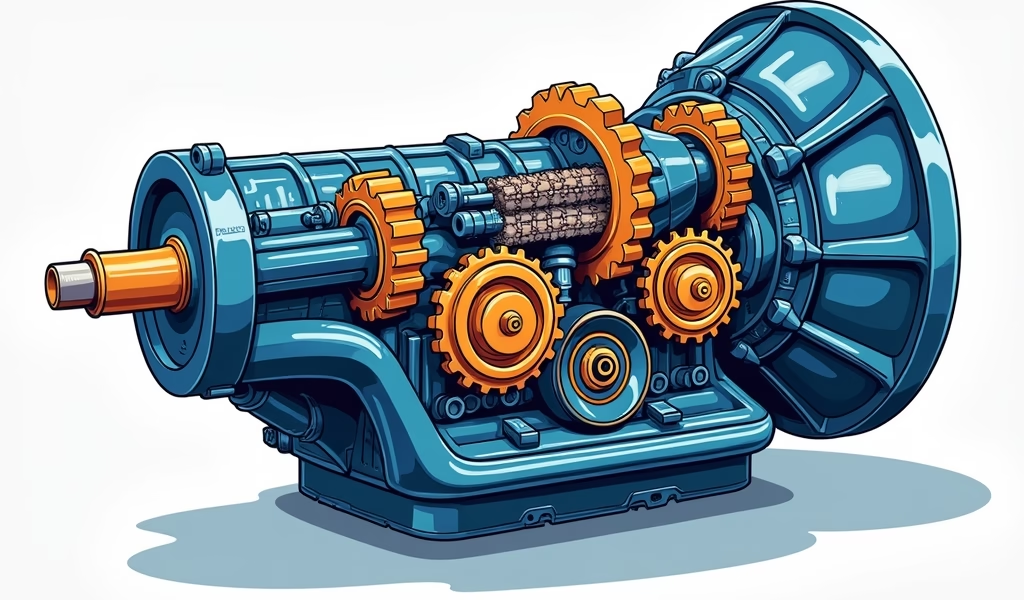
Just like your morning coffee needs the right amount of cream, your Camaro’s transmission needs regular fluid changes and proper driving habits to avoid transforming your muscle car into an expensive paperweight. This detailed guide walks Camaro owners through identifying warning signs, performing DIY maintenance, and developing driving habits that can extend transmission life from the typical 100,000 miles to an impressive 200,000 miles—potentially saving thousands in repair costs.
Table of Contents
- Understanding Your Chevrolet Camaro Transmission
- Common Chevrolet Camaro Transmission Problems
- Warning Signs of Transmission Trouble
- Essential Preventive Maintenance Tips
- The Importance of Regular Fluid Changes
- Driving Habits That Protect Your Transmission
- When to Seek Professional Help
- DIY Maintenance You Can Perform
- Cost Comparison: Maintenance vs. Repair
- Conclusion
- Frequently Asked Questions
Understanding Your Chevrolet Camaro Transmission
The Chevrolet Camaro transmission is a marvel of engineering that deserves your attention and care. As someone who’s spent decades under the hood of these American muscle icons, I can tell you that few components are as crucial—or as expensive to replace—as the transmission. Whether your Camaro features the 6-speed manual, the 8-speed automatic, or the newer 10-speed automatic transmission, proper maintenance is your best defense against costly breakdowns.
The Camaro’s transmission system is designed to handle impressive power outputs, from the base V6 models to the fire-breathing ZL1 variants. But with great power comes great responsibility. Many owners focus on engine performance while overlooking transmission health—a mistake that can lead to repair bills in the thousands.
In this comprehensive guide, we’ll explore how to identify early warning signs of transmission issues, implement preventive maintenance practices, and avoid the driving habits that can shorten your transmission’s lifespan. By the end, you’ll have a mechanic’s perspective on keeping your Camaro shifting smoothly for miles to come.
Common Chevrolet Camaro Transmission Problems
The Chevrolet Camaro transmission, while robust, isn’t immune to problems. Over the years, I’ve seen certain issues appear with greater frequency across different model years. Understanding these common problems can help you stay ahead of potential breakdowns.
For automatic transmissions, particularly in fifth and sixth-generation Camaros, harsh shifting is one of the most frequent complaints. This often manifests as a noticeable jerk or bang when changing gears, especially during downshifts. In many cases, a transmission fluid change or an update to the transmission control module (TCM) software can resolve this issue before it leads to mechanical damage.
Manual transmission Camaros sometimes develop clutch-related issues. Premature clutch wear, difficult engagement, or a chattering clutch can signal problems with the pressure plate, throwout bearing, or hydraulic system. These components work in harmony, and when one begins to fail, it can accelerate wear on the others.
Another issue that appears across both transmission types is overheating. The Camaro’s performance-oriented design can sometimes push transmission temperatures higher than ideal, especially during aggressive driving or towing. Consistently high transmission temperatures accelerate fluid breakdown and can lead to premature failure of seals, clutches, and other internal components.
For owners of 2010-2015 Camaros with automatic transmissions, torque converter shudder has been a documented issue. This feels like driving over rumble strips when the converter locks up at highway speeds. Automotive engineers have identified this as primarily a fluid-related issue that can often be addressed with the correct specification transmission fluid.
Warning Signs of Transmission Trouble
Your Chevrolet Camaro transmission doesn’t just fail without warning. It typically sends several distress signals first, and catching these early can mean the difference between a minor service and a complete rebuild. Let me walk you through the warning signs I tell all my customers to watch for.
Unusual noises are your transmission’s way of crying for help. Whining, buzzing, or clunking sounds—especially when shifting gears or in neutral—should never be ignored. These noises often indicate mechanical problems like worn bearings, damaged gears, or low fluid levels that are actively causing damage.
Delayed engagement is another telltale sign. If you shift from park to drive and there’s a noticeable pause before the car moves, your transmission is struggling. This often relates to hydraulic pressure issues or worn internal components that aren’t engaging properly.
Pay attention to how your Camaro shifts. Rough, jerky shifts or unexplained surging can indicate transmission problems. Modern transmissions should shift almost imperceptibly. When you feel each shift distinctly—or worse, when they’re accompanied by a thud or bang—that’s your car telling you something’s wrong.
Leaking transmission fluid is perhaps the most visible warning sign. The fluid should be clear red, not brown or black, and should never be found underneath your parked vehicle. Even small leaks can lead to big problems if they cause the fluid level to drop below safe operating levels.
The dreaded check engine light often illuminates for transmission-related issues. Modern Camaros have sophisticated onboard diagnostics that can detect problems before they cause catastrophic failure. Don’t dismiss this warning—especially if it’s accompanied by any of the above symptoms.
One particularly concerning sign is a burning smell accompanied by poor performance. This often indicates overheating transmission fluid, which loses its lubricating properties and can quickly lead to major internal damage. If you notice this, safely pull over and let the transmission cool down before continuing.
Essential Preventive Maintenance Tips
Preventing Chevrolet Camaro transmission problems is far less expensive than fixing them after they occur. I’ve saved customers thousands of dollars over the years by emphasizing these preventive maintenance steps.
First and foremost, follow Chevrolet’s recommended transmission service intervals as a minimum baseline. For most Camaros, this means changing the transmission fluid and filter every 45,000 to 60,000 miles for normal driving conditions. However, if you frequently drive in severe conditions (towing, track days, stop-and-go traffic), consider servicing it every 30,000 miles instead.
When changing your transmission fluid, always use the exact specification recommended by GM. Using incorrect fluid is a common mistake that can lead to shifting problems or premature wear. For many modern Camaros, GM specifies Dexron VI for automatic transmissions, but always check your owner’s manual for the specific requirements of your model year.
Consider installing an auxiliary transmission cooler if you frequently push your Camaro hard. Extra cooling capacity can significantly extend transmission life by keeping operating temperatures in the ideal range. This is especially important for automatic transmissions, which generate more heat than their manual counterparts.
Regularly inspect transmission mounts and connections. Worn mounts can allow excessive movement that stresses internal components, while loose connections can lead to fluid leaks or electrical issues with the transmission control systems.
For manual transmission Camaros, clutch maintenance is crucial. Have the hydraulic system inspected regularly and bled when necessary. Adjust the clutch pedal free play according to specifications, and replace the clutch fluid according to the maintenance schedule—many owners overlook this simple service.
Keep an eye on your Camaro’s cooling system too. Since the automatic transmission fluid is often cooled via an exchanger in the radiator, cooling system problems can directly impact transmission temperatures. Ensuring your engine cooling system is in top shape helps protect your transmission as well.
The Importance of Regular Fluid Changes
Let’s talk about transmission fluid—the lifeblood of your Chevrolet Camaro transmission. This specialized fluid performs multiple crucial functions simultaneously: it lubricates moving parts, transfers power hydraulically, cools internal components, and helps clean the system by carrying away debris to the filter. No wonder fresh fluid is so important!
Over time, transmission fluid breaks down from heat and mechanical shearing. It loses its lubricating properties, becomes contaminated with metal particles, and can develop a burnt smell. When this happens, it’s no longer protecting your transmission effectively.
Many modern transmissions are advertised as having “lifetime” fluid that never needs changing. In my professional experience, this is misleading marketing. The “lifetime” they’re referring to is significantly shortened if you never service the transmission. I’ve seen too many “lifetime fluid” transmissions fail prematurely to believe this claim.
For your Camaro, a complete fluid exchange is preferable to a simple drain and fill. This is because a traditional drain only removes about 30-40% of the old fluid, while an exchange can replace up to 90%. The process flushes out old fluid from the torque converter, cooler lines, and valve body—areas a simple drain can’t reach.
When changing fluid in automatic transmissions, pay attention to the condition of what comes out. Dark brown or black fluid with a burnt smell indicates the transmission has been running hot. Small metal particles are normal, but large chunks can signal internal damage requiring further investigation.
For manual transmissions, fluid changes are equally important but often simpler. The fluid doesn’t typically degrade as quickly as automatic transmission fluid, but it still benefits from regular renewal. Most manual transmission issues I see could have been prevented with regular fluid maintenance.
Driving Habits That Protect Your Transmission
How you drive your Camaro has a profound impact on transmission longevity. Over my years working on these beautiful machines, I’ve observed that driver behavior often determines whether a transmission lasts 100,000 miles or 200,000 miles.
Avoid aggressive launches that shock the drivetrain. While it’s tempting to test your Camaro’s acceleration capabilities frequently, repeated hard launches put tremendous strain on transmission components. Save those moments for special occasions, not your daily commute.
Allow your transmission to warm up before demanding performance. Just like your engine, your transmission performs best when it reaches normal operating temperature. In cold weather, give your Camaro a few minutes of gentle driving before pushing it hard.
For automatic transmissions, resist the urge to shift from drive to reverse (or vice versa) while the car is still moving. This “neutral drop” technique creates extreme shock loads that can damage internal components. Come to a complete stop before changing direction.
If you have a manual transmission Camaro, develop smooth clutch habits. Riding the clutch (keeping it partially engaged) generates excessive heat that accelerates wear. Practice clean, decisive shifts and avoid using the clutch as a footrest when not shifting.
When stopped on an incline, use your parking brake rather than holding position with the clutch or in drive. This reduces strain on the transmission components and saves wear on the clutch system in manual models.
Pay attention to the differential service schedule as well, since transmission health is interconnected with proper differential function. Problems in one can create additional stress on the other.
Finally, consider how you’re using your Camaro. If you frequently tow or carry heavy loads, you’re asking more of your transmission than the average owner. In these cases, more frequent fluid changes and inspections are warranted to ensure longevity.
When to Seek Professional Help
While preventive maintenance can go a long way, there comes a time when professional intervention is necessary for your Chevrolet Camaro transmission. Knowing when to take your car to a specialist can save you from more extensive damage.
If you notice fluid leaks, unusual noises, or shifting problems that persist after basic maintenance, it’s time to consult a professional. These symptoms rarely resolve themselves and typically worsen over time if ignored.
When your check engine light illuminates with transmission-related codes, seek professional diagnosis. Modern Camaros have sophisticated control modules that can detect problems long before they cause catastrophic failure. Transmission diagnostic codes often require specialized equipment to properly interpret and address.
After any significant impact or accident, have your transmission inspected even if it seems to be working normally. Physical damage to mounts, cooler lines, or the transmission case may not immediately affect operation but can lead to problems down the road.
Consider seeking professional help if you’re planning to modify your Camaro for increased performance. Transmission upgrades or recalibration may be necessary to handle additional power, and a transmission specialist can guide you through appropriate modifications.
Choose your transmission service provider carefully. Look for shops that specialize in performance vehicles or, better yet, Chevrolet products specifically. General transmission shops may not be familiar with the unique characteristics of Camaro transmissions, especially in high-performance variants like the SS or ZL1.
When you do visit a professional, bring detailed information about any symptoms you’ve noticed and when they occur. This information helps technicians diagnose problems more efficiently and accurately, potentially saving you money on diagnostic time.
DIY Maintenance You Can Perform
While some transmission work requires professional tools and knowledge, there are several maintenance tasks you can perform yourself to keep your Chevrolet Camaro transmission in top shape. These DIY procedures can save you money while giving you a better understanding of your vehicle.
Checking transmission fluid is a basic but vital task for automatic transmission owners. With your engine warmed up and running, the transmission in park, locate the dipstick (typically labeled and with a red handle), remove it, wipe clean, reinsert fully, and check both level and condition. The fluid should be clear red, not brown or black, and at the appropriate mark on the dipstick.
For manual transmissions, checking fluid level typically requires the car to be level with the engine off. You’ll need to locate and remove the fill plug (usually on the side of the transmission case) to verify fluid reaches the bottom of the opening. This is messier than checking automatic fluid but still manageable for a DIY enthusiast.
Inspecting for leaks can be done in your driveway. Place clean cardboard under your parked Camaro overnight, then check for spots in the morning. Transmission fluid typically appears red or pink and has a distinctive sweet smell that differentiates it from engine oil or coolant.
For the moderately skilled DIYer, changing transmission fluid and filters on many Camaro models is achievable. You’ll need a transmission pan gasket, filter, correct specification fluid, and basic tools. Many helpful tutorials are available online specific to your Camaro’s year and transmission type.
Keep in mind that some newer Camaro models with 8-speed or 10-speed automatic transmissions have more complex service procedures that might not be ideal for DIY work. When in doubt, consult your owner’s manual or a model-specific repair guide.
If you’re comfortable with basic electrical troubleshooting, purchasing an OBD-II scanner that reads transmission codes can be invaluable. Modern scanners are affordable and can help you determine whether a transmission issue needs immediate professional attention or is something minor you can address yourself.
Cost Comparison: Maintenance vs. Repair
The financial reality of Chevrolet Camaro transmission care presents a stark contrast between prevention and repair. Let me break down the numbers to illustrate why regular maintenance makes economic sense.
A typical transmission fluid and filter service for a Camaro costs between $150-$300 at most independent shops. This includes quality fluid, a new filter, and labor. If you choose to do it yourself, the cost drops to around $80-$150 for materials.
Compare this to the cost of major transmission repairs: rebuilding a Camaro automatic transmission typically ranges from $2,500-$4,000, while a complete replacement can exceed $5,000 for newer models with 8 or 10-speed transmissions. Manual transmissions aren’t much cheaper, with rebuilds starting around $1,800 and replacements often exceeding $3,000.
The math is straightforward: you could pay for 15-20 fluid services for the cost of one major transmission replacement. Given that regular maintenance can help your transmission last 200,000 miles or more, the investment in prevention is clearly worthwhile.
Beyond the direct financial comparison, consider the hidden costs of transmission failure. These include towing expenses, rental car needs during repair time, lost work hours, and the inconvenience of unexpected vehicle downtime. These secondary costs can add hundreds or even thousands to the total expense of a transmission failure.
For those who plan to keep their Camaro long-term, the value proposition of maintenance becomes even clearer. A well-maintained transmission not only saves repair costs but also preserves resale value. Potential buyers are often willing to pay a premium for vehicles with documented maintenance records showing proper care.
Remember that timing matters too. Addressing small issues early—like a minor leak or slight shift irregularity—typically costs far less than waiting until the problem escalates. Many transmission specialists offer free inspections that can catch these issues before they become expensive problems.
Conclusion
Your Chevrolet Camaro transmission is a precision-engineered component that deserves attention and care. Throughout this guide, we’ve explored the various aspects of transmission maintenance that can save you from expensive repairs while preserving your driving enjoyment.
Remember that prevention is always less expensive than repair. Regular fluid changes, attentive driving habits, and prompt response to warning signs are your best defenses against transmission failure. The few hundred dollars you might spend on maintenance can save you thousands in repair costs down the road.
Listen to your Camaro. It will tell you when something isn’t right with subtle changes in performance, unusual noises, or warning lights. These early indicators provide the opportunity to address issues before they become catastrophic failures.
Whether you own a classic first-generation Camaro or a modern sixth-gen powerhouse, the principles of transmission care remain largely the same. Respect the engineering, follow maintenance schedules, and your Chevrolet Camaro transmission will reward you with years of trouble-free performance.
Take pride in caring for your American muscle car properly. The effort you put into maintenance not only protects your investment but also ensures you’ll continue to experience the exhilarating performance that made you choose a Camaro in the first place. Your transmission might not be the most glamorous component of your Camaro, but it’s certainly one of the most important—and now you have the knowledge to keep it performing at its best.
Frequently Asked Questions
How often should I change the transmission fluid in my Chevrolet Camaro?
For most Camaros under normal driving conditions, change the transmission fluid every 45,000-60,000 miles. If you frequently drive in severe conditions (high heat, heavy traffic, towing), consider changing it more frequently at 30,000-mile intervals.
What are the signs of a failing Camaro transmission?
Watch for unusual noises, delayed engagement, rough shifting, fluid leaks, burning smells, and warning lights. Any of these symptoms warrant immediate attention to prevent more extensive damage.
Can I change my Camaro’s transmission fluid myself?
Yes, for many Camaro models, a DIY fluid change is possible with basic tools and the correct fluid specification. However, newer models with 8 or 10-speed transmissions may require specialized equipment for a complete fluid exchange.
Is it normal for a Camaro transmission to make noise?
No, a properly functioning transmission should operate quietly. Whining, grinding, clunking, or buzzing noises indicate potential problems that should be inspected promptly.
What’s the average lifespan of a Chevrolet Camaro transmission?
With proper maintenance, a Camaro transmission can last 150,000-200,000 miles or more. Without regular maintenance, that lifespan could be reduced to 80,000-120,000 miles, especially under demanding driving conditions.