

Overview
Just like your smartphone, your Cadillac Lyriq’s charging system needs proper care—from keeping the charge port clean to following the 20-80% battery rule for optimal longevity. This guide offers practical troubleshooting steps to resolve common charging issues yourself before heading to the dealership, potentially saving hundreds in unnecessary service costs while maximizing your Lyriq’s battery health and charging efficiency.
Table of Contents
- Understanding Cadillac Lyriq Charging
- Common Charging Issues
- Quick Fixes to Save Money
- Optimizing Home Charging Setup
- Maximizing Battery Health
- Troubleshooting Charging Problems
- When to Seek Professional Help
- Conclusion
- Frequently Asked Questions
Understanding Cadillac Lyriq Charging
The Cadillac Lyriq represents Cadillac’s bold step into the luxury electric vehicle market, and its charging system is a critical component that owners need to understand. As someone who’s worked on EVs since they first hit the mainstream, I’ve seen how proper charging habits can make or break the ownership experience.
At its core, the Lyriq features a 100 kWh battery pack that supports multiple charging options. The standard 11.5 kW onboard charger handles AC charging at home or at public Level 2 stations, while DC fast charging capability allows for rapid charging up to 190 kW at compatible stations.
Three charging levels are available to Lyriq owners:
- Level 1 (120V): The portable charger included with your vehicle plugs into standard household outlets, adding roughly 3-4 miles of range per hour. It’s slow but convenient for occasional use.
- Level 2 (240V): Using a home charging station or public Level 2 chargers, you’ll gain about 52 miles of range per hour – perfect for overnight charging.
- DC Fast Charging: For road trips and quick top-ups, DC fast chargers can add approximately 76 miles of range in just 10 minutes under optimal conditions.
Understanding these basics helps diagnose potential issues and set realistic expectations for your Lyriq’s charging performance. When customers come into my shop frustrated about charging speeds, I often find the root cause is misunderstanding what their specific charging setup can deliver.
Common Charging Issues
After working with dozens of Lyriq owners, I’ve noticed several recurring charging problems that cause unnecessary frustration. Recognizing these issues early can save you time, money, and the headache of an unexpected dead battery.
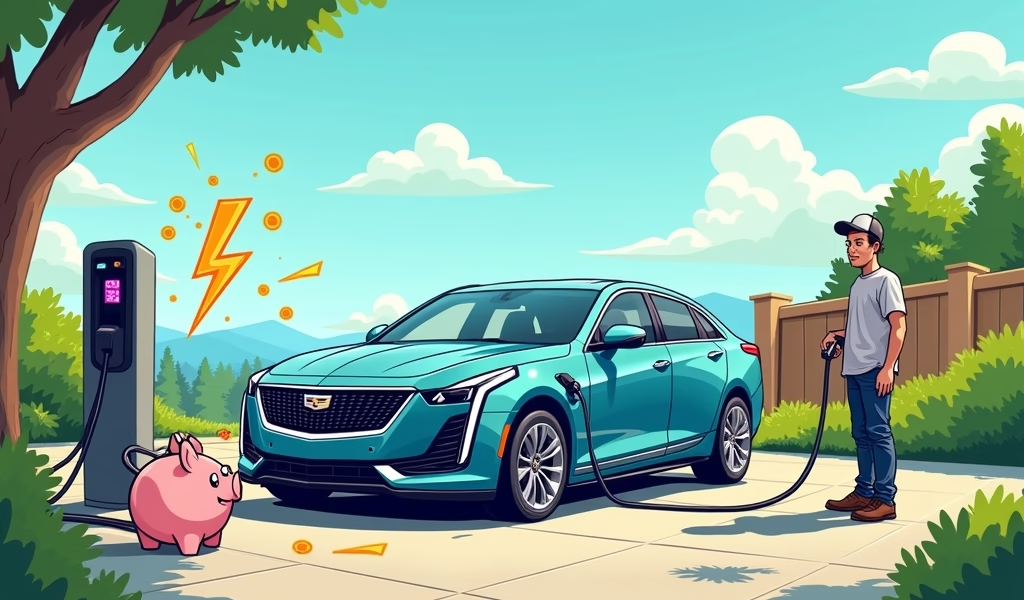
Slow charging is the most frequent complaint I hear. If your Lyriq is taking significantly longer to charge than normal, don’t ignore it. What should take 7-8 hours might suddenly require 12+ hours, severely disrupting your routine. This often happens gradually, making it easy to miss until it becomes a major problem.
Charging interruptions are another common headache. Your car might start charging normally, then stop unexpectedly before reaching the desired level. The myCadillac app may show these interruptions, but many owners don’t check it regularly enough to catch patterns.
Error messages on your vehicle’s display shouldn’t be dismissed. Codes like “Reduced Charging Rate” or “Charging Equipment Fault” are your car’s way of communicating specific problems that need attention. I recommend keeping a small notebook in your glove compartment to record any error codes – they’re invaluable when diagnosing issues.
Temperature-related charging slowdowns catch many owners off guard, especially those in extreme climates. The Lyriq’s battery management system intentionally reduces charging speed when the battery is too hot or cold. While this protects your battery, it can be frustrating when you’re in a hurry.
Connection issues at the charge port can create intermittent charging problems that seem to come and go randomly. These are particularly frustrating because they’re inconsistent and hard to replicate when you’re trying to diagnose them.
Quick Fixes to Save Money
Before rushing to the dealership and facing a hefty service bill, try these proven fixes that resolve many common charging issues. As someone who’s seen countless charging problems, I can assure you that many solutions are simpler than you might think.
Start with the basics: inspect and clean your charge port. Power down your Lyriq completely, then use a dry microfiber cloth to gently wipe the metal contacts inside the port. For stubborn debris, lightly dampen the cloth with isopropyl alcohol (90% or higher). I’ve seen charging speeds improve dramatically after this simple 5-minute procedure.
Check your charging cable for damage. Examine the entire length, paying special attention to the connectors and any points where the cable typically bends. Look for cracks, unusual stiffness, or discoloration. According to a Department of Energy study, cable issues cause approximately 30% of home charging problems.
Perform a charging system reset when experiencing persistent issues:
- Power off your vehicle completely
- Disconnect from charging
- Wait 5 full minutes (time it – this allows onboard systems to fully power down)
- Restart your Lyriq and reconnect to charging
Update your vehicle’s software regularly. Cadillac frequently releases updates that improve charging efficiency and fix known bugs. These updates are free and can be installed wirelessly in most cases. I’ve seen software updates resolve mysterious charging problems that had stumped even experienced technicians.
Verify your home electrical supply if you’re experiencing inconsistent charging at home. Circuit overloads can cause charging to slow or stop entirely. Try charging when other high-draw appliances are off, or consider a dedicated circuit for your charger if problems persist.
Optimize charging settings through the vehicle interface or myCadillac app. Set charging schedules to take advantage of off-peak electricity rates – many utilities offer significantly lower rates overnight. This simple adjustment can reduce charging costs by 30-50% without requiring any hardware changes.
Optimizing Home Charging Setup
Your home charging setup can make a tremendous difference in both charging speed and cost efficiency. Having installed hundreds of home charging stations, I’ve seen how small adjustments can lead to significant improvements.
First, consider upgrading from the included portable charger to a permanent wall-mounted Level 2 charging station. While the upfront cost ranges from $400-800 plus installation, the convenience of 5-7× faster charging makes it worthwhile for most owners. Many utilities offer rebates that can offset this cost substantially.
Location matters more than you might think. Install your charger close to your electrical panel if possible, as longer cable runs increase voltage drop and installation costs. Place it where the charging cable can easily reach your Lyriq’s port without straining, typically on the garage wall closest to where your car’s driver side faces when parked.
Electrical capacity should be carefully considered. A dedicated 50-amp circuit provides optimal charging speed for the Lyriq, though a 40-amp circuit is sufficient for most needs. According to charging infrastructure experts, undersized wiring is responsible for many charging efficiency problems and potential safety issues.
Weather protection is essential for outdoor installations. If your charger must be mounted outside, invest in a quality weather cover and ensure the unit has appropriate outdoor ratings. The small additional cost prevents premature failure of expensive equipment.
Consider future-proofing your installation. While the Lyriq’s onboard charger maxes out at 11.5 kW, installing wiring capable of handling higher loads gives you flexibility for future vehicles or charger upgrades. The labor cost of installation is typically the largest expense, so doing it right once makes financial sense.
Maximizing Battery Health
Proper charging habits directly impact your Lyriq’s battery longevity and performance. In my years working with electric vehicles, I’ve seen batteries maintain 90%+ capacity after 100,000 miles with good care – or deteriorate prematurely with poor habits.
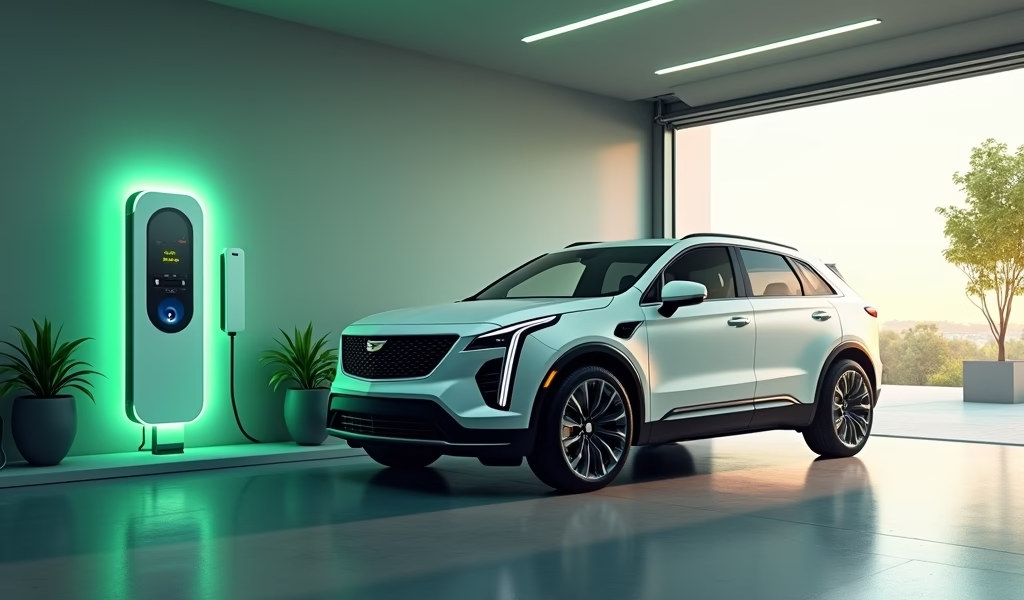
The “80/20 rule” is the single most important practice for battery longevity. For daily driving, try to keep your battery between 20% and 80% charged. This middle range puts minimal stress on the battery cells and significantly reduces degradation over time. Save the 100% charges for long trips when you truly need maximum range.
Use the Lyriq’s charge scheduling feature to finish charging shortly before departure rather than immediately upon plugging in. This minimizes the time your battery spends at high state of charge, which battery experts identify as a key factor in premature aging.
Temperature management makes a substantial difference in battery health. Use your Lyriq’s precondition feature whenever possible while the vehicle is still plugged in – this warms or cools the battery using grid power instead of battery power. In extreme temperatures, try to park in climate-controlled spaces when possible. Heat above 90°F is particularly hard on lithium-ion batteries, potentially accelerating capacity loss.
Avoid frequent DC fast charging when possible. While convenient for road trips, the high heat generated during rapid charging puts stress on battery cells. The Lyriq’s sophisticated cooling system helps mitigate this, but limiting fast charging to road trips rather than regular use is still best practice for battery longevity.
Battery conditioning cycles help maintain balanced cell voltages. Occasionally (perhaps monthly), allow your battery to discharge to about 20%, then charge to 90%. This helps the battery management system calibrate its range estimates and keeps cells balanced for optimal performance.
Troubleshooting Charging Problems
When charging issues arise, a systematic approach helps identify the cause without unnecessary dealership visits. After diagnosing hundreds of EV charging problems, I’ve developed a reliable troubleshooting sequence that works for most situations.
Start by isolating the problem. Is the issue occurring at home, at public chargers, or both? Does it happen consistently or intermittently? This context narrows down potential causes significantly. For example, problems only at home typically point to your charging equipment or electrical supply, while issues at all locations usually indicate a vehicle-side problem.
For home charging problems, verify your power supply. Check your circuit breaker for trips or signs of overheating. Test other high-draw appliances on the same circuit to see if they’re affected. If your charger has status lights, confirm they show normal operation when not connected to the vehicle.
Try a different charging cable if available. In my workshop, we see cable failures regularly – often with no visible external damage. A backup cable is a worthwhile investment at around $150-200 and can quickly prove whether your primary cable is the culprit.
For error messages, consult the owner’s manual or Cadillac support forums where other owners may have encountered similar issues. Don’t ignore error codes – they’re specifically designed to help diagnose problems accurately. The pattern and timing of error messages often provide valuable clues about the underlying issue.
Test at different charging stations if possible. If your Lyriq charges normally at some locations but not others, the problem likely lies with the problematic stations rather than your vehicle. This is particularly common with older public chargers that may not communicate properly with newer vehicles.
Monitor charging behavior in different weather conditions. If problems only occur during extreme temperatures, your battery management system may be intentionally reducing charging rates to protect the battery. In these cases, preconditioning before charging can often resolve the issue.
When to Seek Professional Help
While many charging issues can be resolved with the DIY approaches we’ve discussed, some situations warrant professional attention. Knowing when to seek help can prevent minor issues from becoming major problems.
Persistent error messages that return after system resets or software updates indicate underlying problems that require diagnostic equipment. Particularly concerning are high-voltage system errors or battery fault codes, which should never be ignored. These could indicate safety issues that need immediate attention.
If your Lyriq displays a significant and sudden reduction in range (more than 20%) that doesn’t recover after a few charge cycles, it’s time for a professional evaluation. This could indicate battery cell problems that will only worsen if left unaddressed.
Unusual noises, smells, or heat during charging are red flags that require immediate professional assessment. Normal charging operation should be nearly silent except for occasional cooling fan activation. Any buzzing, clicking, or electrical arcing sounds aren’t normal and potentially indicate serious issues.
When seeking service, you have options beyond the dealership. While Cadillac dealers have specialized training and equipment for the Lyriq, qualified independent EV service centers can often provide more affordable alternatives for out-of-warranty vehicles. Look for shops with ASE-certified technicians with specific EV qualifications.
Remember that charging system repairs may be covered under warranty. The Lyriq comes with an 8-year/100,000-mile warranty on EV components including the battery and charging system. Even minor issues should be documented with your dealer to establish a service history if problems persist or worsen over time.
Conclusion
Maintaining your Cadillac Lyriq’s charging system doesn’t need to be complicated or expensive. With regular attention to the basics—cleaning connections, inspecting cables, updating software, and using optimal settings—you can prevent many common issues and save substantial money on unnecessary service visits.
The investment of time in understanding and properly maintaining your charging system pays dividends in convenience, vehicle longevity, and reduced operating costs. Most charging problems develop gradually, giving attentive owners plenty of opportunity to address small issues before they become major headaches.
Remember that your charging habits directly impact battery health, which represents the most valuable component in your Lyriq. The simple practice of keeping your battery between 20-80% charge for daily driving can potentially add years to your battery’s useful life.
By implementing the straightforward maintenance steps and charging practices outlined in this guide, you’ll ensure your Cadillac Lyriq delivers the reliable, efficient performance you expect from a premium electric vehicle. Your wallet—and future self—will thank you for the care you take today.
Frequently Asked Questions
How long does it take to fully charge a Cadillac Lyriq?
With a Level 2 charger, a full charge from empty takes approximately 6-7 hours. Using DC fast charging, you can add about 76 miles of range in 10 minutes under optimal conditions.
Can I use Tesla charging stations with my Lyriq?
You can use Tesla Destination chargers with an adapter, but Superchargers aren’t currently compatible with the Lyriq. This will change as Tesla opens its network to other EVs and provides necessary adapters.
Why does my Lyriq charge slower in cold weather?
Cold temperatures increase the battery’s internal resistance, forcing the battery management system to reduce charging rates for protection. Using the precondition feature before charging significantly improves cold-weather charging performance.
Is it bad to charge my Lyriq to 100% every day?
Yes, routinely charging to 100% accelerates battery degradation over time. For daily use, setting a maximum charge limit of 80-90% is recommended to maximize battery longevity.
How can I reduce my home charging costs?
Program your Lyriq to charge during off-peak electricity hours when rates are lowest, typically overnight. Many utilities offer time-of-use plans that can reduce charging costs by 30-50% through simple scheduling.