

Overview
Accurate automotive diagnostic equipment is crucial for avoiding the estimated $25 billion wasted annually on unnecessary repairs, with misdiagnosis affecting about 23% of vehicle repairs due to outdated or improperly used tools. Quality diagnosis depends on regularly updated equipment, technician expertise, and proper methodology—making it worthwhile to invest in shops with current technology rather than relying solely on inexpensive consumer-grade scanners that may miss 30-40% of potential issues.
Table of Contents
- Why Diagnostic Equipment Accuracy Matters
- Understanding Car Diagnostic Equipment
- Signs Your Diagnosis Might Be Inaccurate
- Factors That Affect Diagnostic Accuracy
- How to Choose a Shop with Quality Equipment
- DIY Diagnostics vs. Professional Equipment
- How to Avoid Costly Misdiagnosis
- Conclusion
- Frequently Asked Questions
We’ve all been there. That dreaded check engine light illuminates your dashboard, and suddenly you’re faced with the prospect of unexpected repair bills. What’s even worse? Paying for repairs only to have that stubborn light reappear a few days later. Or visiting three different shops and getting completely different diagnoses each time.
This frustrating cycle isn’t just annoying—it’s expensive. According to research from the Automotive Service Association, about 23% of vehicle repairs happen unnecessarily due to misdiagnosis. American drivers waste over $25 billion annually on repairs they simply don’t need.
The culprit behind these costly mistakes? Often, it’s outdated or improperly used diagnostic equipment. When the tools used to identify your vehicle’s problems aren’t accurate, you might as well be throwing darts blindfolded at a parts catalog.
Why Diagnostic Equipment Accuracy Matters
Think about visiting a doctor who prescribes medication based on an outdated thermometer reading. You’d likely get the wrong treatment. The same principle applies to your vehicle when diagnostic equipment fails.
Accurate diagnostics create a direct path to appropriate repairs. When diagnostic equipment provides incorrect information, technicians may replace perfectly good parts while missing the actual problem. For example, faulty readings might suggest an issue with your catalytic converter—a $1,000+ repair—when the real problem is just a $150 oxygen sensor.
Beyond wasting your money, there’s an environmental impact. Every prematurely replaced part represents wasted resources and unnecessary manufacturing. It’s estimated that unnecessary auto parts replacement adds over 1.5 million tons of waste to landfills annually.
Perhaps most concerning is the cascading effect of incorrect repairs. Replacing the wrong component can create new problems or mask underlying issues that worsen over time, potentially leading to more extensive damage or safety hazards.
Understanding Car Diagnostic Equipment

Modern vehicles are essentially computers on wheels, with dozens of electronic control units monitoring everything from fuel mixture to tire pressure. When something goes wrong, these computers store trouble codes that can trigger dashboard warning lights.
Diagnostic tools serve as translators that help technicians understand what your car is communicating. But not all equipment is created equal.
Types of Diagnostic Equipment
- OBD-II scanners: The most common diagnostic tools that connect to your vehicle’s On-Board Diagnostics port. Basic scanners simply read and clear codes, while advanced models provide real-time data and access to multiple vehicle systems.
- Dealer-level diagnostic systems: Sophisticated platforms designed specifically for certain manufacturers. These systems can access every electronic module in the vehicle and perform specialized functions like programming new components. They’re expensive ($5,000 to $20,000) but provide comprehensive capabilities.
- Specialty equipment: Tools focused on specific vehicle systems, like transmission signal testers or exhaust analyzers. Specialty shops often invest in these targeted diagnostic tools.
Your vehicle communicates through specific protocols—digital languages that vary by make, model, and year. For accurate diagnosis, the equipment must support your vehicle’s specific protocol. This is why that $30 code reader from an online store might not tell the whole story.
Signs Your Diagnosis Might Be Inaccurate
How can you tell if diagnostic equipment might be leading you astray? Watch for these red flags:
- Inconsistent error codes between readings. If a technician scans your vehicle multiple times and receives different results each time, the equipment may not be reliable.
- Warning lights return immediately after repair. While some vehicles require a “learning period” after repairs, warning lights that reappear within days typically signal an unresolved issue.
- Multiple shops provide wildly different diagnoses for the same symptoms. While some variation in approach is normal, completely contradictory diagnoses suggest someone’s tools or techniques are falling short.
- Repairs don’t solve the problem despite following diagnostic recommendations. If you’ve had repeated repairs that don’t fix the issue, either the diagnosis is incomplete or the repair isn’t addressing the root cause.
I recently worked with a customer who had replaced their mass airflow sensor three times based on a simple code reader diagnosis. When we examined the vehicle with our updated equipment, we discovered the real problem was a corroded wiring harness connector—a $15 fix instead of repeated $200 sensors.
Factors That Affect Diagnostic Accuracy
Several key factors determine whether diagnostic equipment will deliver reliable information:
Equipment Quality and Calibration
Like any measuring device, diagnostic tools require regular calibration and updates. Equipment that hasn’t been properly maintained may provide inconsistent or misleading results. Professional shops typically update their diagnostic software quarterly to keep pace with new vehicle models and technical service bulletins.
Technician Expertise
The most advanced diagnostic equipment is only as good as the person using it. A skilled technician knows how to interpret data, recognize patterns, and validate findings before recommending repairs. This is why experience matters—a seasoned tech can often diagnose accurately with basic equipment, while an inexperienced tech might miss critical clues even with top-tier tools.
Software Updates and Compatibility
Vehicle systems evolve constantly, and diagnostic equipment must keep pace. Many manufacturers release software updates multiple times per year. Shops that fall behind may struggle to diagnose newer models accurately or access critical vehicle telemetry data.
Environmental Conditions
Extreme temperatures, humidity, and electromagnetic interference can affect diagnostic readings. Quality equipment includes compensation mechanisms for these variables, but budget tools may provide less reliable results under challenging conditions.
Vehicle Electrical System Condition
Older vehicles with corroded connections or deteriorating wiring can generate inconsistent signals that confuse diagnostic equipment. In these cases, a thorough visual inspection may be as important as electronic diagnosis. Even battery voltage can significantly impact readings—most professionals verify proper system voltage before beginning diagnostics.
How to Choose a Shop with Quality Equipment
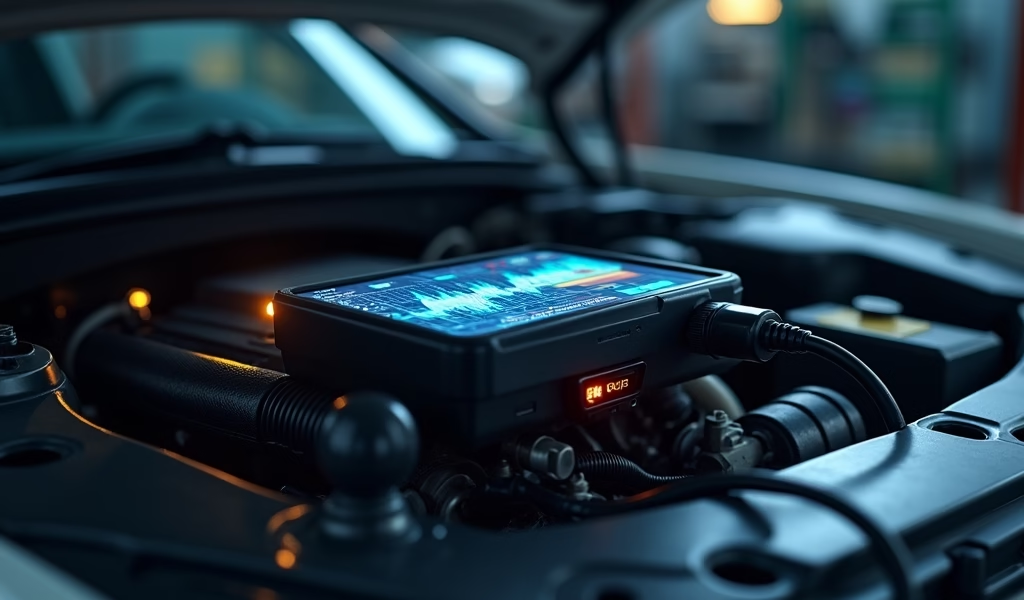
Finding a shop that invests in quality diagnostic equipment can save you thousands in unnecessary repairs. Here’s what to look for:
Ask These Questions
- “How often do you update your diagnostic software?” Good shops will have a regular schedule and won’t hesitate to share it.
- “What’s your process for verifying diagnostic results?” Listen for answers that include multiple testing methods, not just reading codes.
- “Do you have equipment specific to my vehicle make?” Especially important for European or luxury vehicles that often require specialized diagnostic tools.
Look for These Signs
- Technician certifications displayed (ASE, manufacturer-specific training)
- Clean, organized shop environment (often reflects their approach to maintenance)
- Willingness to show you the diagnostic process
- Detailed explanations of findings rather than just pushing repairs
Understand Diagnostic Pricing
Quality diagnosis takes time and proper equipment—both come at a cost. Basic diagnostic fees typically range from $75-150 at independent shops and $100-200 at dealerships. More complex issues may require enhanced diagnostics ($150-300), especially for intermittent problems.
Remember: A thorough $150 diagnostic that correctly identifies the problem will save you far more than a $50 quick scan that leads to unnecessary parts replacement. The cheapest diagnostic isn’t always the most economical choice.
DIY Diagnostics vs. Professional Equipment
The market for consumer diagnostic tools has exploded, giving car owners more insight into their vehicles than ever before. But understanding these tools’ limitations is crucial.
Consumer-Grade Diagnostic Tools
- Basic code readers ($20-50): Simply retrieve and clear basic fault codes
- Bluetooth OBD-II adapters ($15-100): Connect to smartphone apps for basic code reading and some live data
- Advanced consumer scanners ($100-300): Provide more comprehensive data and sometimes access to multiple vehicle systems
These tools are useful for identifying common issues and monitoring basic parameters. However, they typically can’t access all vehicle systems or perform bidirectional controls (commanding components to activate for testing).
DIY diagnosis works well for:
- Identifying common issues like oxygen sensor failures
- Verifying repairs of simple problems
- Basic monitoring of vehicle parameters
- Pre-purchase checks of used vehicles
Professional diagnosis becomes necessary when:
- Problems involve multiple systems or are intermittent
- Issues don’t trigger obvious codes
- Specialized testing is required
- Component activation or programming is needed
Many professional technicians recommend a collaborative approach: use DIY tools for initial insight, then use that knowledge when consulting with professionals. Understanding the basic trouble codes helps you ask better questions and evaluate repair recommendations more effectively.
How to Avoid Costly Misdiagnosis
Whether you’re a DIY enthusiast or working with a professional shop, these strategies will help you avoid the pitfalls of inaccurate diagnostics:
Never Rush to Replace Parts
Trouble codes point to circuits or systems with issues, not necessarily specific parts that need replacement. For example, a P0302 code indicates cylinder #2 is misfiring—but the cause could be a bad spark plug, ignition coil, fuel injector, vacuum leak, or even low compression. Proper diagnosis requires verification testing beyond just reading codes.
Document Everything
Keep detailed records of when problems occur (hot/cold engine, specific speeds, turning, etc.), note any recent repairs, and record whether warning lights are steady or intermittent. This context helps technicians focus their diagnosis and may reduce diagnostic time and cost.
Get a Second Opinion When Appropriate
If a diagnosis involves expensive repairs or doesn’t seem to match your vehicle’s symptoms, don’t hesitate to seek another assessment. When doing so, don’t initially share the first diagnosis—this allows the second technician to approach the problem without bias.
Test After Repairs
Quality repairs should include verification testing to confirm the issue has been corrected. Don’t accept “we’ll know if it comes back” as an answer. Proper shops will road test and verify through diagnostic equipment that the repair has resolved the underlying problem.
Balance Cost and Thoroughness
The most accurate diagnostic approach takes time, which costs money. But rushing the process often leads to misdiagnosis and more expense down the road. A proper diagnosis should include:
- Initial code retrieval and analysis
- Verification testing to confirm codes are accurate
- Review of technical service bulletins related to your symptoms
- Testing of related systems that might cause similar symptoms
- A clear explanation of findings and repair options
Conclusion
Accurate vehicle diagnosis depends on quality equipment, skilled technicians, and proper methods. By understanding how diagnostic tools work and what factors affect their accuracy, you can make informed decisions about your vehicle repairs and avoid costly mistakes.
Remember that the most expensive part of any repair is often not the initial diagnosis—it’s paying for unnecessary repairs that don’t fix the problem. Investing in accurate diagnosis from shops with quality, up-to-date equipment and experienced technicians will save you money, time, and frustration in the long run.
Building a relationship with a trustworthy repair facility might be the most valuable step you can take. Find someone who explains their process, acknowledges limitations, and prioritizes fixing the root cause rather than just selling parts. Your wallet—and your vehicle—will thank you.
Frequently Asked Questions
How accurate are OBD scanners I can buy online for under $100?
Consumer-grade scanners can accurately retrieve basic trouble codes but often lack access to manufacturer-specific codes and advanced systems. They’re useful for preliminary diagnosis but may miss 30-40% of potential issues that professional equipment can identify.
Can diagnostic equipment give false readings if my car battery is low?
Absolutely. Low voltage can cause erratic module behavior and false error codes. If your battery is below 12.4 volts (with the engine off), diagnostic results may be unreliable.
Why do different repair shops sometimes give different diagnostic results?
Variations in equipment quality, technician experience, and diagnostic approach all contribute to different results. Additionally, some problems are intermittent—present during one diagnosis but not another.
How often should professional diagnostic equipment be updated?
Industry best practices suggest software updates quarterly and calibration verification annually. Shops working on diverse vehicle makes should update even more frequently to keep pace with manufacturer-specific changes.
Is dealer diagnostic equipment always better than independent shop tools?
Not necessarily. While dealers have access to manufacturer-specific tools, many independent shops invest in high-quality aftermarket diagnostic systems that match or exceed dealer capabilities. The technician’s skill often matters more than minor equipment differences.
HTML:
Why Diagnostic Equipment Accuracy Matters
Think about visiting a doctor who prescribes medication based on an outdated thermometer reading. You’d likely get the wrong treatment. The same principle applies to your vehicle when diagnostic equipment fails.
Accurate diagnostics create a direct path to appropriate repairs. When diagnostic equipment provides incorrect information, technicians may replace perfectly good parts while missing the actual problem. For example, faulty readings might suggest an issue with your catalytic converter—a $1,000+ repair—when the real problem is just a $150 oxygen sensor.
Beyond wasting your money, there’s an environmental impact. Every prematurely replaced part represents wasted resources and unnecessary manufacturing. It’s estimated that unnecessary auto parts replacement adds over 1.5 million tons of waste to landfills annually.
Perhaps most concerning is the cascading effect of incorrect repairs. Replacing the wrong component can create new problems or mask underlying issues that worsen over time, potentially leading to more extensive damage or safety hazards.
Understanding Car Diagnostic Equipment
Modern vehicles are essentially computers on wheels, with dozens of electronic control units monitoring everything from fuel mixture to tire pressure. When something goes wrong, these computers store trouble codes that can trigger dashboard warning lights.
Diagnostic tools serve as translators that help technicians understand what your car is communicating. But not all equipment is created equal.
Types of Diagnostic Equipment
- OBD-II scanners: The most common diagnostic tools that connect to your vehicle’s On-Board Diagnostics port. Basic scanners simply read and clear codes, while advanced models provide real-time data and access to multiple vehicle systems.
- Dealer-level diagnostic systems: Sophisticated platforms designed specifically for certain manufacturers. These systems can access every electronic module in the vehicle and perform specialized functions like programming new components. They’re expensive ($5,000 to $20,000) but provide comprehensive capabilities.
- Specialty equipment: Tools focused on specific vehicle systems, like transmission signal testers or exhaust analyzers. Specialty shops often invest in these targeted diagnostic tools.
Your vehicle communicates through specific protocols—digital languages that vary by make, model, and year. For accurate diagnosis, the equipment must support your vehicle’s specific protocol. This is why that $30 code reader from an online store might not tell the whole story.