

Overview
Wheel bearing grease isn’t just some random goop you slather on car parts—it’s the unsung superhero that prevents your wheels from throwing a fiery temper tantrum at 70mph. This article details the importance of selecting high-quality wheel bearing grease (with recommendations for top products like Lucas Oil Red ‘N’ Tacky and Mobil 1 Synthetic), proper application techniques, maintenance schedules based on driving conditions, and common mistakes to avoid for optimal vehicle safety and performance.
Table of Contents
- Understanding Wheel Bearing Grease
- Importance of Quality Wheel Bearing Grease
- What to Look for in Wheel Bearing Grease
- Top 6 Wheel Bearing Greases
- How to Apply Wheel Bearing Grease Properly
- Common Mistakes to Avoid When Using Wheel Bearing Grease
- Maintenance Schedule for Wheel Bearing Regreasing
- Conclusion
- Frequently Asked Questions
Understanding Wheel Bearing Grease
Wheel bearing grease is the unsung hero of your vehicle’s smooth operation. It’s that thick, sticky substance that keeps your wheels spinning freely while carrying the full weight of your vehicle. As someone who’s been elbow-deep in wheel hubs for over two decades, I can tell you that choosing the right grease makes all the difference between a quiet, trouble-free ride and an expensive repair job waiting to happen.
Think of wheel bearing grease as the tiny army that fights against friction, heat, and moisture in one of your car’s most critical areas. Unlike regular multipurpose greases, wheel bearing grease is specially formulated to withstand extreme pressures and temperatures that wheel bearings experience. When you’re cruising down the highway at 70 mph, those bearings are spinning thousands of times per minute – that’s a lot of heat and friction to manage!
The composition of wheel bearing grease typically includes a base oil (mineral or synthetic), a thickener (often lithium complex), and various additives that enhance performance. These additives might include rust inhibitors, anti-wear compounds, and extreme pressure additives. Some premium greases also contain molybdenum disulfide or PTFE (Teflon) for enhanced lubrication properties.
Not all greases are created equal, and using the wrong type can lead to premature bearing failure or even catastrophic wheel loss. That’s why understanding what makes a good wheel bearing grease is crucial for maintaining your car properly and keeping yourself safe on the road.
Importance of Quality Wheel Bearing Grease
I’ve seen too many preventable wheel bearing failures in my shop – failures that could have been avoided with the right grease and proper maintenance. Quality wheel bearing grease is not just a recommendation; it’s a necessity for the safety and longevity of your vehicle.
When wheel bearings fail, they rarely give you much warning. You might notice a humming noise that increases with speed, or perhaps some slight wheel wobble. By the time these symptoms become obvious, you’re often looking at complete bearing replacement rather than simple maintenance. In worst-case scenarios, bearing failure can lead to a wheel separating from your vehicle entirely – a frightening prospect at any speed.
Temperature resistance is one of the most critical properties of quality wheel bearing grease. Your brakes can generate temperatures of several hundred degrees, and this heat transfers to nearby wheel bearings. Poor-quality grease might literally melt and run out of the bearing assembly, leaving metal-on-metal contact that quickly leads to catastrophic failure.
Water resistance is another vital factor, especially if you live in rainy regions or frequently drive through puddles or snow. Quality wheel bearing grease creates a waterproof barrier that prevents moisture from causing rust and corrosion inside your wheel bearings. This is particularly important for boat trailers or vehicles that may be partially submerged during boat launching.
The right wheel bearing grease also protects against contamination. Road grit, salt, and other debris can work their way into wheel bearings, acting like sandpaper on precision surfaces. Good grease helps seal out these contaminants while maintaining its protective film even under extreme pressure.
Investing in quality wheel bearing grease is one of the most cost-effective ways to avoid expensive repairs and maintain your vehicle’s safety. When you consider that premium grease might cost just a few dollars more than budget options, yet can prevent hundreds or thousands in repair bills, the choice becomes obvious to any knowledgeable car owner.
What to Look for in Wheel Bearing Grease
Choosing the right wheel bearing grease can feel overwhelming with so many options available. Here’s what you should look for when making your selection:
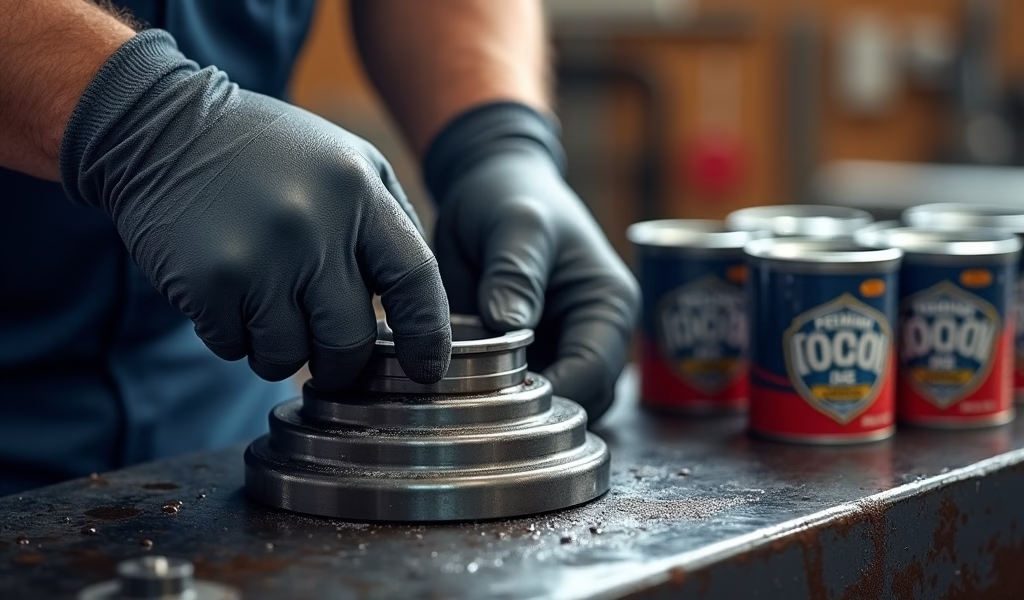
First, check the NLGI (National Lubricating Grease Institute) grade. For most wheel bearing applications, NLGI #2 is ideal – it’s thick enough to stay put but workable enough to distribute evenly around the bearings. You’ll see this as a number on the container, typically ranging from 000 (very fluid) to 6 (very stiff).
Temperature range is critical. Look for grease that can handle temperatures from -40°F to at least 300°F for normal driving. If you tow heavy loads or drive in mountainous regions, consider greases rated for even higher temperatures, as your brakes and bearings will generate more heat under these conditions.
Water resistance is indicated by “washout resistance” on many product labels. This measures how well the grease stays in place when exposed to water. For vehicles that may encounter wet conditions, look for greases with excellent washout ratings or specifically labeled as “marine grade” or “waterproof.”
Base oil type matters significantly. Synthetic base oils generally outperform conventional mineral oils, especially in temperature extremes. They’re more expensive but offer better protection and longer service life – a worthwhile investment for most vehicles.
Additives enhance performance in specific ways. Look for greases with anti-wear additives, rust inhibitors, and extreme pressure (EP) additives. Some premium greases contain molybdenum disulfide (often called “moly”) or PTFE (Teflon) for superior lubrication under heavy loads.
Compatibility with bearing materials and seals is essential. Most modern wheel bearing greases are compatible with the common rubber seals and metals used in wheel bearings, but always check manufacturer recommendations, especially for older or specialty vehicles.
According to a Society of Tribologists and Lubrication Engineers study, using the correct grease specification can extend bearing life by up to 30% compared to using incorrect or low-quality lubricants. That’s a significant improvement for such a small investment!
Top 6 Wheel Bearing Greases
After testing dozens of products and seeing the real-world results in my shop, here are my top recommendations for wheel bearing greases that deliver excellent protection and value:
1. Lucas Oil 10005 Red ‘N’ Tacky Grease
Lucas Red ‘N’ Tacky is a true workhorse that’s earned its reputation among mechanics and DIYers alike. This bright red NLGI #2 lithium complex grease features exceptional tackiness that helps it cling to bearing surfaces even under extreme pressure and high RPM operation. Temperature resistance ranges from -40°F to 300°F, making it suitable for most driving conditions.
What makes this grease stand out is its excellent water resistance and mechanical stability. I’ve seen bearings packed with Lucas Red ‘N’ Tacky come back looking fresh even after thousands of miles in wet conditions. It contains rust and oxidation inhibitors that provide long-term protection, and its distinctive red color makes it easy to see when inspecting bearings for adequate coverage.
2. Mobil 1 Synthetic Grease
Mobil 1 Synthetic represents the premium end of wheel bearing greases, with performance to match its higher price point. This lithium complex grease uses a fully synthetic base oil that provides exceptional thermal stability and resistance to breakdown. Its temperature range is impressive at -40°F to 350°F, making it particularly suitable for high-performance applications or severe driving conditions.
The synthetic formulation gives this grease outstanding pumpability at low temperatures while maintaining excellent film strength at high temperatures. In my experience, Mobil 1 excels in reducing bearing noise and vibration, and its resistance to oxidation means it maintains its protective properties for extended periods. This is my go-to recommendation for luxury vehicles and performance cars where longevity and quietness are priorities.
3. Valvoline Multipurpose Grease
Don’t let the “multipurpose” label fool you – Valvoline’s offering is entirely suitable for wheel bearing applications while being versatile enough for other automotive uses. This lithium-based NLGI #2 grease offers solid temperature performance (-10°F to 300°F) at a very reasonable price point, making it an excellent choice for budget-conscious vehicle owners.
Valvoline’s formulation includes effective rust and corrosion inhibitors along with oxidation stabilizers that help extend service life. While it may not have all the extreme performance characteristics of specialty products, it provides reliable protection for daily drivers in moderate conditions. I often recommend this to customers who maintain their vehicles regularly and don’t subject them to extreme conditions.
4. Timken GR224C Premium Wheel Bearing Grease
When a company that manufactures bearings makes grease specifically for those bearings, it’s worth paying attention. Timken’s premium wheel bearing grease is a calcium-sulfonate complex formulation that excels in water resistance and load-carrying capacity. Its temperature range of -40°F to 325°F covers virtually all normal driving conditions.
What impressed me most about this grease is its exceptional mechanical stability – it maintains its consistency even after extensive working. The calcium-sulfonate thickener provides inherent rust protection without additional additives, making this an excellent choice for vehicles operated in coastal areas or regions where road salt is used. Though somewhat harder to find than some other brands, it’s worth seeking out for its outstanding performance.
5. CRC SL3141 Heavy-Duty Marine Wheel Bearing Grease
For those who tow boats or operate vehicles near water, CRC’s marine-grade wheel bearing grease offers specialized protection. This vibrant blue aluminum complex grease is formulated specifically for exceptional water resistance, with remarkable resistance to washout even in marine environments. It maintains stability in temperatures from -10°F to 325°F.
CRC’s formulation includes additives that actively repel water while providing excellent corrosion protection. In my experience, this grease outperforms standard automotive greases in high-moisture environments by a significant margin. It’s a bit stiffer than some other options (NLGI #2.5), which helps it stay in place even when repeatedly exposed to water. For boat trailers and vehicles used near water, this is my unequivocal recommendation.
6. Bel-Ray Waterproof Grease
Bel-Ray’s Waterproof Grease has built a strong reputation in the motorcycle and powersports world, but it’s equally effective for automotive wheel bearings. This calcium-complex NLGI #2 grease offers exceptional water resistance and mechanical stability. Its operating temperature range of -40°F to 325°F makes it versatile for various applications.
What sets Bel-Ray apart is its excellent performance under shock loading and vibration, conditions that are particularly relevant to wheel bearings. The formulation includes effective extreme pressure additives that protect bearings during sudden impacts and load changes. I’ve found this grease to be particularly long-lasting in off-road vehicles and those subjected to rough road conditions, maintaining its protective properties even when other greases might break down.
How to Apply Wheel Bearing Grease Properly
Proper application of wheel bearing grease is just as important as choosing the right product. I’ve seen too many bearing failures caused by improper greasing techniques, so let me walk you through the correct process.
Start with clean hands and a clean workspace. Contamination is the enemy of bearings, so minimize the risk of dirt entering the system. Remove the wheel, then the dust cap, cotter pin, castle nut, and finally the outer bearing. Carefully remove the hub assembly to access the inner bearing.
Thoroughly clean both bearings using a high-quality parts cleaner or mineral spirits. I prefer to soak them for at least 30 minutes, then use a small brush to remove old grease and contaminants. Inspect each bearing carefully for pitting, discoloration, or roughness – signs that replacement is needed rather than regreasing.
Completely remove all old grease from the hub and clean the races (the surfaces where bearings rotate). Check these surfaces for scoring or damage. If you see significant wear patterns, consider replacing the entire hub assembly, as damaged races can quickly destroy new bearings.
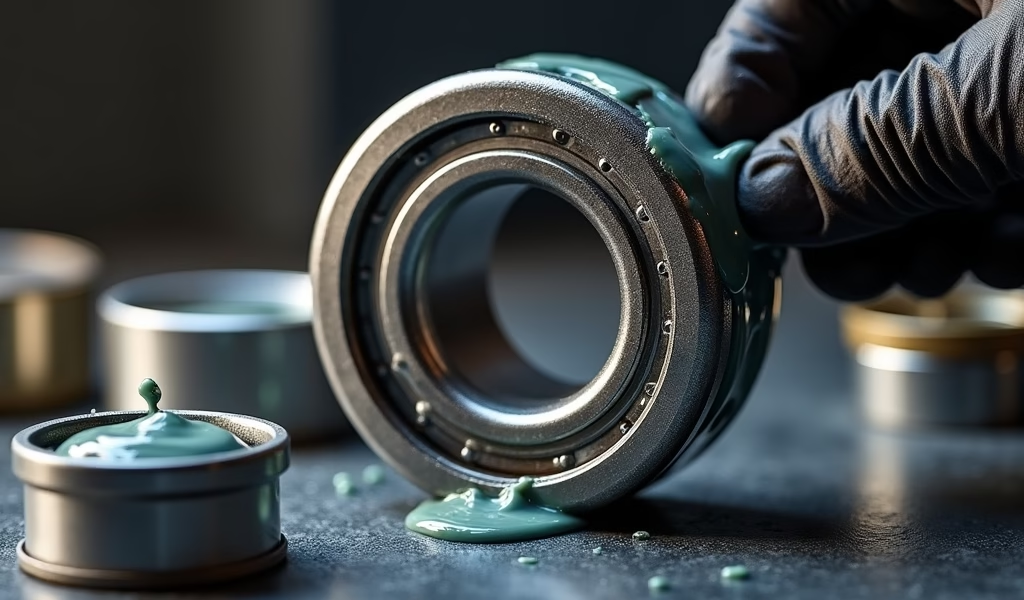
When applying fresh grease, use the palm method for thorough coverage: place a golf ball-sized amount of grease in your palm, then press the large end of the bearing into this grease. Force the grease up through the bearing until it emerges from the small end. Rotate the bearing and repeat until grease completely fills the spaces between all rollers.
Apply a thin coat of grease to the races inside the hub. Pack the hub itself about 1/3 full with grease – any more is unnecessary and can lead to overheating. A common mistake is over-packing, which can actually push grease into brake components and reduce braking efficiency.
When reassembling, follow manufacturer torque specifications for the spindle nut. Proper preload on the bearings is critical – too tight causes overheating, while too loose allows harmful movement. Generally, you’ll tighten the nut fully, then back off slightly (typically 1/4 turn) before installing the cotter pin.
As noted by Machine Design engineers, proper installation accounts for nearly 40% of bearing life extension, making your technique nearly as important as your choice of grease.
Common Mistakes to Avoid When Using Wheel Bearing Grease
In my years as a mechanic, I’ve witnessed plenty of well-intentioned maintenance go wrong. Here are the most common mistakes people make when dealing with wheel bearing grease – and how you can avoid them.
Mixing incompatible greases is probably the most frequent error I encounter. Different thickener types can react negatively with each other, causing the mixture to break down and fail prematurely. Lithium complex grease generally doesn’t play well with aluminum complex or calcium sulfonate formulations. When changing grease types, take the time to thoroughly clean out all old grease first.
Contamination during the repacking process can introduce abrasive particles that act like sandpaper inside your bearings. Always work in a clean environment and keep your grease container closed when not actively using it. Even tiny dust particles can significantly shorten bearing life.
Over-greasing is surprisingly common and potentially harmful. Excessive grease creates internal pressure and heat as the bearing operates. This pressure can damage seals, while the heat can cause the grease to break down faster. The correct amount fills the spaces between rollers without creating a “packed” feeling when the bearing is rotated by hand.
Using the wrong consistency (NLGI grade) for your application can lead to problems. Too soft, and the grease might leak out; too firm, and it may not distribute properly around the bearing elements. Most automotive wheel bearings are designed for NLGI #2 grease, but always check your vehicle’s service manual to be sure.
Ignoring temperature ratings leads many people to use inappropriate grease for their driving conditions. If you live in Minnesota and use grease with a low-temperature limit of 0°F, you’re setting yourself up for failure. Similarly, towing in summer heat requires grease with a high maximum temperature rating.
Forgetting to check for compatibility with seals can cause expensive problems. Some aggressive synthetic formulations can swell or degrade certain rubber compounds. If your vehicle has special seal materials, verify that your chosen grease is compatible to avoid seal failure and subsequent bearing damage.
Remember that many essential vehicle fluids, including wheel bearing grease, have specific requirements that should never be overlooked for proper vehicle maintenance.
Maintenance Schedule for Wheel Bearing Regreasing
How often should you repack your wheel bearings? It’s a question I hear frequently, and the answer isn’t one-size-fits-all. Several factors influence the ideal maintenance interval for your particular situation.
For most passenger vehicles under normal driving conditions, repacking wheel bearings every 30,000 miles or 3 years is a good rule of thumb. This interval has served my customers well for decades. However, this assumes you’re using quality grease and your driving habits fall within “normal” parameters.
Towing regularly? Cut that interval in half. The additional weight increases bearing load and operating temperatures, causing grease to break down faster. I advise customers who tow boats, campers, or utility trailers to repack their wheel bearings annually or every 15,000 miles, whichever comes first.
Driving in extreme conditions also warrants more frequent maintenance. If you regularly traverse dusty dirt roads, ford streams, drive on beaches, or endure harsh winter road salt, consider annual repacking regardless of mileage. These conditions introduce contaminants and moisture that can compromise even the best grease.
Listen to your vehicle for warning signs that might indicate early servicing is needed. A humming or growling noise that changes with speed (but not with steering input) often indicates bearing wear. Any grinding, clicking, or roughness when rotating the wheel by hand (with the vehicle safely supported on jack stands) is a red flag requiring immediate attention.
Don’t forget about trailer wheel bearings! These often need more frequent attention than tow vehicles because trailer bearings:
- May sit unused for extended periods, allowing rust to form
- Often lack the sophisticated seals found on automotive bearings
- Frequently get submerged during boat launching
- May not benefit from the cooling airflow that moving vehicles receive
For boat trailers, I strongly recommend repacking bearings at least annually, regardless of mileage. Some boaters wisely do this task at the beginning of each season. If your trailer has bearing protectors (those small grease fittings on the dust caps), add a few pumps of fresh grease before each major trip, but don’t rely on this as a substitute for proper repacking.
Keep detailed maintenance records including the date, mileage, and type of grease used. This information becomes invaluable for establishing your ideal maintenance interval based on real-world results rather than general guidelines. As you gain experience with your specific vehicle under your driving conditions, you can refine your schedule for optimal bearing life.
Conclusion
Wheel bearing grease might seem like a minor detail in the grand scheme of vehicle maintenance, but it’s one of those small things that makes an enormous difference in reliability, safety, and long-term operating costs. The humble wheel bearing carries immense responsibility – supporting your vehicle’s weight while allowing smooth rotation thousands of times per minute – and proper lubrication is its primary defense against failure.
Among our top picks, each product offers specific advantages for different situations. Lucas Oil Red ‘N’ Tacky provides excellent all-around performance for most vehicles, while Mobil 1 Synthetic delivers premium protection for high-performance applications. Valvoline offers solid protection at a budget-friendly price, Timken brings bearing manufacturing expertise to their specialized formula, and both CRC and Bel-Ray excel in waterproof applications.
The key takeaway is that investing in quality wheel bearing grease and maintaining a proper regreasing schedule will pay dividends in extended component life and peace of mind. When you consider that wheel bearing failure can lead to anything from inconvenient roadside breakdowns to dangerous wheel separation incidents, the importance of this simple maintenance task becomes clear.
Remember that proper application technique is just as important as product selection. Take your time, work clean, and follow the recommended procedures for your specific vehicle. Your bearings will reward you with tens of thousands of trouble-free miles.
Whether you’re a dedicated DIYer or someone who relies on professional service, understanding wheel bearing grease helps you make informed decisions about your vehicle’s maintenance. In either case, don’t overlook this critical component – those small bearings shoulder a big responsibility for your safety and your vehicle’s longevity.
Frequently Asked Questions
What’s the difference between regular grease and wheel bearing grease?
Wheel bearing grease is specifically formulated to withstand high temperatures and pressures found in wheel bearings. It typically has better water resistance and mechanical stability than regular grease.
Can I mix different types of wheel bearing grease?
It’s not recommended to mix different grease types as they may have incompatible thickeners. Thoroughly clean all old grease before applying a different type.
How do I know if my wheel bearings need new grease?
Listen for humming or growling noises that change with speed but not with steering. Regular maintenance should be performed every 30,000 miles or if your vehicle experiences unusual noise or vibration.
Is synthetic wheel bearing grease worth the extra cost?
Synthetic grease typically offers better temperature resistance and longer service life. For high-performance vehicles, towing applications, or severe conditions, the additional cost is usually justified.
Can I use marine grease for regular car wheel bearings?
Marine grease works well for automotive wheel bearings, especially in wet environments. It typically offers excellent water resistance but verify it meets the temperature requirements for your vehicle.