

Overview
This practical guide offers proven strategies to reduce fuel consumption through proper vehicle maintenance, efficient driving habits, and smart load management, with techniques that can improve fuel economy by 10-20%. The article emphasizes that small, consistent changes—from maintaining proper tire pressure and regular tune-ups to smoother acceleration and removing excess weight—can lead to significant savings at the pump while benefiting the environment.
Table of Contents
- Understanding Fuel Efficiency: What Affects Your Vehicle’s Thirst
- Maintenance Tips That Boost Your MPG
- Driving Habits That Preserve Your Fuel Tank
- Load Management: Lightening Your Vehicle’s Burden
- Advanced Fuel-Saving Strategies
- Long-Term Solutions for Maximum Efficiency
- Conclusion: Small Changes, Big Savings
- Frequently Asked Questions
In a world where fuel prices seem to play hopscotch with our budgets, learning how to reduce fuel consumption isn’t just smart—it’s necessary. Every time I see a customer wince at their gas receipt, I’m reminded why I share these tips daily at my shop. The beauty is, you don’t need to trade in your beloved ride for something that runs on hopes and dreams to see real savings. After 20 years under the hood, I’ve gathered practical strategies that can help any vehicle sip rather than gulp from the pump.
What’s more, reducing your fuel consumption doesn’t just protect your wallet—it’s kinder to our planet. Each gallon saved means fewer emissions in our atmosphere. It’s a win-win that I’m passionate about as both a mechanic and a fellow driver watching those digits spin at the pump.
Let’s get your vehicle running leaner without compromising performance. These aren’t theoretical tips—they’re proven techniques I’ve seen work on thousands of vehicles in my bay.
Understanding Fuel Efficiency: What Affects Your Vehicle’s Thirst
Before we pop the hood on specific solutions, let’s talk about what actually influences fuel consumption. Your car isn’t mysteriously deciding to drink more fuel—there are concrete factors at play: your vehicle’s design and maintenance, driving style, environmental conditions, and even how you’ve packed your trunk.
Start by establishing your baseline. Most folks have no idea what their actual fuel economy is, making improvement impossible to track. Record your mileage between fill-ups and calculate how many gallons you’re burning. Many newer models display real-time MPG on the dashboard, which is incredibly helpful for immediate feedback.
Be realistic about improvements. If you’re driving a 2001 pickup truck, you won’t suddenly get compact car efficiency. However, even a 10% improvement can mean substantial savings. A vehicle averaging 20 MPG that improves to 22 MPG saves about 23 gallons of fuel over 10,000 miles—that’s nearly $100 at current prices, just from modest changes.
Maintenance Tips That Boost Your MPG
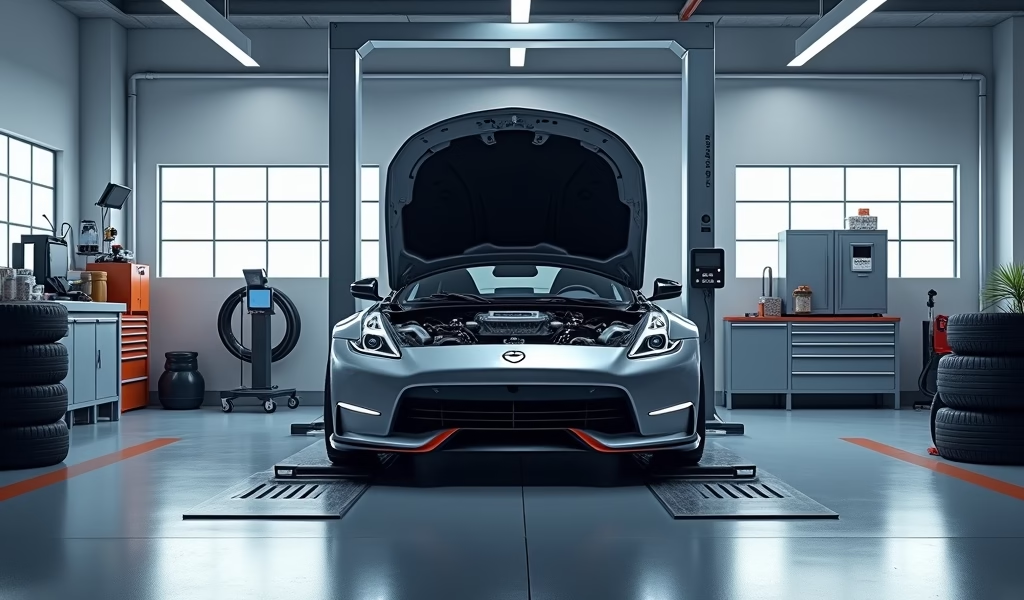
The health of your vehicle directly impacts its fuel efficiency. Here’s what I focus on when customers come in looking to improve their MPG:
Keep Your Engine Tuned
A properly tuned engine simply runs more efficiently. I’ve seen vehicles gain up to 4% better fuel economy after a basic tune-up. When major issues like oxygen sensor failures are fixed, that improvement can jump to a whopping 40%, according to Department of Energy research. Don’t ignore that check engine light—it’s often signaling something that’s costing you at the pump.
Tire Pressure: The Unsung Hero
I can’t tell you how many vehicles roll into my shop with severely underinflated tires. This single issue creates additional rolling resistance, forcing your engine to work harder. Check your tire pressure monthly—your proper inflation numbers are usually listed on a sticker inside your driver’s door jamb, not on the tire itself.
Proper tire inflation can improve gas mileage by up to 3%. For the average driver, that’s like getting a free gallon of gas every few fill-ups. While you’re at it, regular rotation ensures even wear, extending tire life and maintaining optimal efficiency.
Speaking of tires, proper wheel alignment is crucial for reducing drag and uneven wear. When your wheels fight against each other, your fuel economy suffers.
Air Filters: Your Engine’s Lungs
Your engine needs to breathe properly. A clogged air filter chokes airflow, throwing off your air-fuel ratio. Replacing a dirty air filter can improve fuel economy by up to 10% in older cars with carbureted engines. While modern fuel-injected engines adjust better to restricted airflow, they still perform more efficiently with clean filters.
I recommend checking your air filter every 6,000 miles. If you can’t see light through it when holding it up, it’s time for replacement—a simple DIY task that costs about $15-20 for most vehicles.
The Right Motor Oil Makes a Difference
Using the manufacturer-recommended grade of motor oil can improve your mileage by 1-2%. Look for oils labeled as “Energy Conserving”—these contain friction-reducing additives that help your engine run more smoothly.
And please, don’t skip oil changes. Clean oil reduces internal engine friction, allowing components to move more freely and efficiently.
Driving Habits That Preserve Your Fuel Tank
Even the most perfectly maintained vehicle can guzzle gas with poor driving habits. Here’s what I tell my customers about driving for efficiency:
Easy Does It: Smooth Acceleration and Braking
The single most effective driving change you can make? Take it easy on the gas pedal. Aggressive driving—jackrabbit starts and hard braking—can lower highway gas mileage by up to 30%. I tell folks to imagine an egg between their foot and the pedal—press too hard and you’ll waste fuel along with breaking that egg.
Anticipate traffic flow to maintain momentum. Coming to a complete stop means you’ll need more fuel to get back up to speed. When you see a red light ahead, ease off the gas early and coast when possible.
Find Your Speed Sweet Spot
Most vehicles reach their optimal fuel efficiency between 45-65 mph. Above that range, aerodynamic drag increases exponentially. Each 5 mph over 50 mph essentially adds about $0.20 per gallon in fuel costs.
On highways, cruise control is your friend. It maintains a constant speed better than your right foot can, preventing the unconscious creep in speed that happens to the best of us.
Idle Thoughts
That old advice about warming up your car for several minutes? It dates back to carbureted engines and isn’t necessary with modern vehicles. Today’s engines need no more than 30 seconds of warm-up, even in winter.
If you’re stopped for more than a minute (except in traffic), turning off your engine saves more fuel than restarting. Modern starters are designed for frequent use, so don’t worry about wearing it out.
Route Planning Pays Off
The shortest route isn’t always the most fuel-efficient. Routes with fewer stops, less traffic, and more consistent speeds typically use less fuel even if they’re slightly longer in distance. Navigation apps that factor in traffic conditions can help you find the most efficient route.
I also recommend combining errands whenever possible. Several short trips from a cold start can use twice as much fuel as one longer trip covering the same distance. Your engine operates most efficiently when warm, so plan your errands in a logical sequence to minimize cold starts.
Load Management: Lightening Your Vehicle’s Burden
Your vehicle works harder when carrying unnecessary weight or facing increased wind resistance. Here’s how to lighten its load:
Clean Out Your Car
That collection of sports equipment, tools, or random items permanently living in your trunk? They’re costing you money with every mile. An extra 100 pounds reduces fuel economy by about 1%—not huge, but it adds up over time.
I had a customer who cleared out nearly 200 pounds of “just in case” items from his SUV and saw his average MPG improve by about 2%. That’s like getting a free gallon of gas every other fill-up, just for decluttering.
Roof Racks and Cargo Boxes: The MPG Killers
Those roof-mounted cargo boxes and bike racks are serious fuel economy killers when not in use. They disrupt your vehicle’s aerodynamics significantly, decreasing fuel economy by 2-8% in city driving and 6-17% on highways. Remove them when you’re not actively using them.
If you must transport items outside the vehicle, trunk-mounted racks generally cause less drag than roof-mounted options.
Distribute Weight Properly
When you do need to carry heavier loads, proper weight distribution improves handling and fuel efficiency. Keep heavier items lower in the vehicle and distribute weight evenly from side to side.
Advanced Fuel-Saving Strategies

Once you’ve mastered the basics, consider these more advanced approaches to fuel economy:
Smart Climate Control
Your air conditioning can increase fuel consumption by up to 20% in city driving. At lower speeds (under 40 mph), open windows typically have less impact on fuel economy than AC. At highway speeds, however, open windows create significant drag, making AC the more efficient choice.
On mild days, try using just the fan with outside air, or open windows at lower speeds. When you do need AC, setting it a few degrees higher can reduce its energy demands.
Invest in Fuel-Efficient Tires
When it’s time to replace your tires, consider fuel-efficient models. These low rolling resistance tires can improve fuel economy by 1-4%, according to NHTSA studies. While they sometimes cost more upfront, the fuel savings over their lifespan often offset the price difference.
Leverage Technology
Use the technology available to you. Many GPS systems can suggest fuel-efficient routes that avoid traffic congestion and hills. Smartphone apps can track fuel economy, monitor driving habits, and even gamify efficient driving.
If your vehicle has different driving modes, experiment with “Eco” mode when appropriate. These settings often modify throttle response and transmission shift points to favor efficiency over performance.
Consider Alternative Fuels
Depending on your location and vehicle, alternative fuels like ethanol blends or biodiesel might be available. While not suitable for all vehicles, these can sometimes reduce emissions and costs. Always check your owner’s manual before using alternative fuels.
Long-Term Solutions for Maximum Efficiency
When you’re ready for bigger changes, consider these approaches:
Vehicle Selection Matters
The most impactful decision for fuel economy is your vehicle choice. When purchasing your next vehicle, compare fuel economy ratings carefully. Even within the same vehicle class, fuel efficiency can vary significantly between models.
I’m not suggesting everyone needs a compact car or hybrid—just that choosing the more efficient model within your desired vehicle category can yield substantial savings over the vehicle’s life.
Explore Hybrid and Electric Options
If your driving habits and infrastructure support it, hybrid and electric vehicles offer dramatic improvements in energy efficiency. Modern hybrids no longer feel like a compromise, offering performance alongside their efficiency benefits.
For many of my customers, the switch to a hybrid has cut their fuel costs in half. Electric vehicles eliminate fuel costs entirely, though they do add to your electric bill.
Consider Alternative Transportation
For some trips, the most fuel-efficient vehicle might not be a car at all. Public transportation, carpooling, biking, or walking can eliminate fuel costs entirely for certain journeys. I know this might sound strange coming from an auto mechanic, but the most efficient mile is the one you don’t drive at all.
Conclusion: Small Changes, Big Savings
Improving fuel efficiency doesn’t require drastic lifestyle changes or a brand new vehicle. The combined effect of proper maintenance, mindful driving, and smart planning can reduce fuel consumption by 10-20% for most drivers. That translates to hundreds of dollars saved annually and a significant reduction in environmental impact.
Start with the simplest changes—check your tire pressure, remove excess weight, adopt smoother driving habits. These require minimal effort but deliver noticeable improvements. As these become habit, incorporate more advanced strategies for even greater efficiency.
Remember that consistency is key. A one-time tune-up won’t deliver lasting results if you revert to aggressive driving or neglect regular maintenance. Think of fuel efficiency as an ongoing practice rather than a quick fix.
In my decades working with vehicles, I’ve seen countless customers transform their fuel economy through these methods. The most successful ones treat it as a game—constantly looking for ways to squeeze a few more miles from each gallon. Not only do they save money, but they also report enjoying their driving experience more as they become more attuned to their vehicle’s needs and performance.
Your journey to better fuel economy starts with your next trip. Which of these strategies will you try first?
Frequently Asked Questions
Does premium fuel improve fuel economy?
For most vehicles, no. Unless your owner’s manual specifically requires premium fuel, using it typically doesn’t improve fuel economy enough to offset its higher cost.
How much does a dirty air filter affect fuel economy?
In older vehicles, a clogged air filter can reduce fuel economy by up to 10%. Modern fuel-injected engines compensate better but still perform more efficiently with clean filters.
Is it better to idle or restart the engine for short stops?
If you’ll be stopped for more than 60 seconds (except in traffic), turning off the engine saves more fuel. Modern starters are designed to handle frequent use without excessive wear.
Do fuel additives actually improve gas mileage?
Most aftermarket fuel additives provide little to no measurable improvement in fuel economy. Quality gasoline already contains the necessary detergents and additives for optimal performance.
How often should I check my tire pressure?
Check your tire pressure at least once a month and before long trips. Tires can lose pressure due to temperature changes and slow leaks even without obvious damage.
Pingback: Energy Efficiency Initiative: Stop Wasting Gas & Save Big - knowsyourcar.com
Pingback: Sustainable practice implementation: avoid costly repairs - knowsyourcar.com