
Overview
This article explains how hybrid and electric powertrains work, covering everything from basic components to advanced technologies like regenerative braking, battery systems, and efficiency comparisons with conventional vehicles. It provides practical insights on the maintenance, performance benefits, and future developments of electrified vehicles, written from the perspective of an experienced mechanic.
Table of Contents
- Understanding Powertrain Basics
- Conventional vs. Alternative Powertrains
- Hybrid Powertrain Fundamentals
- Types of Hybrid Systems
- Key Hybrid Components
- Electric Vehicle Powertrains
- EV Battery Technology
- Regenerative Braking
- Efficiency and Performance
- Maintenance Considerations
- Future of Electrified Powertrains
- Conclusion
- Frequently Asked Questions
Understanding Powertrain Basics
Let’s start with the fundamentals of How Hybrid and Electric Powertrains Work by first understanding what a powertrain actually is. Think of the powertrain as your vehicle’s muscle system – it’s everything that works together to make your wheels turn. In a traditional car, this includes the engine, transmission, driveshaft, and differentials. The powertrain takes the energy stored in fuel and converts it into the mechanical energy that moves your vehicle down the road.
The evolution of powertrains has been fascinating to witness throughout my 25 years as a mechanic. We’ve come a long way from simple internal combustion engines to sophisticated hybrid and all-electric systems. These advanced powertrains represent a fundamental shift in how vehicles convert and utilize energy.
What makes electrified powertrains so different is their approach to energy conversion. While conventional engines burn fuel in a one-way process, hybrid and electric powertrains can capture, store, and reuse energy that would otherwise be lost. This is where the magic happens – and it’s also where many of my customers’ questions begin.
Conventional vs. Alternative Powertrains
Before diving deep into the intricacies of hybrid and electric systems, it helps to understand how they differ from conventional powertrains. Your traditional gas-powered vehicle relies solely on an internal combustion engine (ICE). When you press the accelerator, fuel mixes with air, a spark ignites it, and the resulting explosion pushes pistons that ultimately rotate your wheels. It’s a tried-and-true system, but it’s also inherently inefficient – typically converting only about 20-30% of fuel energy into actual movement.
Alternative powertrains aim to address this efficiency problem. Hybrid systems pair an internal combustion engine with one or more electric motors and a battery to capture and reuse energy. Meanwhile, fully electric vehicles eliminate combustion entirely, relying solely on battery-stored electricity to power motors that drive the wheels.
The shift toward electrification isn’t just about better efficiency. It’s also about reducing emissions, decreasing reliance on fossil fuels, and creating vehicles with unique performance characteristics. Electric motors deliver instant torque – that immediate push you feel when accelerating – which gives even everyday electric vehicles surprisingly responsive performance.
Hybrid Powertrain Fundamentals
Hybrid powertrains represent an ingenious middle ground between conventional and fully electric vehicles. At their core, hybrids combine two power sources – typically a gasoline engine and one or more electric motors – working in concert to maximize efficiency and performance. The beauty of a hybrid system lies in its ability to use the right power source at the right time.
When you’re sitting in traffic or driving at low speeds, many hybrids can operate in electric-only mode, drawing power from the battery pack and using zero gas. Need to accelerate quickly? The gas engine kicks in to provide additional power. Cruising at highway speeds? The system might run primarily on the gas engine while simultaneously charging the battery. It’s a complex dance of energy management that happens automatically.
What makes hybrid systems truly special is their ability to capture energy that would otherwise be wasted. When you apply the brakes in a conventional vehicle, kinetic energy converts to heat through friction and dissipates into the air. Hybrids, however, use regenerative braking to capture much of this energy, converting it back to electricity and storing it in the battery for later use.
The marriage between combustion and electric power isn’t just about fuel economy. Hybrid vehicles offer numerous advantages including reduced emissions, extended range compared to pure EVs, and often require no lifestyle changes like charging infrastructure. Many customers are surprised to learn that modern hybrids can frequently achieve 50+ MPG in real-world driving conditions.
Types of Hybrid Systems
Not all hybrid vehicles are created equal. Over my years working with these vehicles, I’ve seen several distinct architectures emerge, each with unique characteristics and benefits. Understanding these differences helps explain why some hybrids feel and perform differently than others.
Parallel Hybrids
The most common hybrid architecture is the parallel hybrid. In this system, both the gasoline engine and electric motor can directly power the wheels. Think of it as having two separate paths to move your car – either power source can drive the wheels independently, or they can work together for maximum performance. The Toyota Prius, which pioneered the mass-market hybrid, uses a sophisticated version of this approach.
Series Hybrids
In a series hybrid (sometimes called a range-extended electric vehicle), the gasoline engine never directly powers the wheels. Instead, it works exclusively as a generator to produce electricity for the electric motor, which is the sole source of propulsion. The Chevrolet Volt’s system operated primarily in this manner when its battery was depleted. This approach allows for very smooth operation since the gas engine can run at its most efficient speed regardless of vehicle speed.
Plug-in Hybrids (PHEVs)
Plug-in hybrids represent the bridge between conventional hybrids and fully electric vehicles. They feature larger battery packs that can be charged from an external electricity source (like your home outlet), enabling significant all-electric driving range – typically between 20-50 miles – before the gas engine needs to activate. For many of my customers who make mostly short trips but occasionally travel longer distances, PHEVs offer the perfect compromise.
Each hybrid type has its place in the market, and the best choice depends on your driving habits, access to charging, and performance expectations. According to U.S. Department of Energy research, the average American drives less than 40 miles per day, putting many commutes well within the all-electric range of modern plug-in hybrids.
Key Hybrid Components
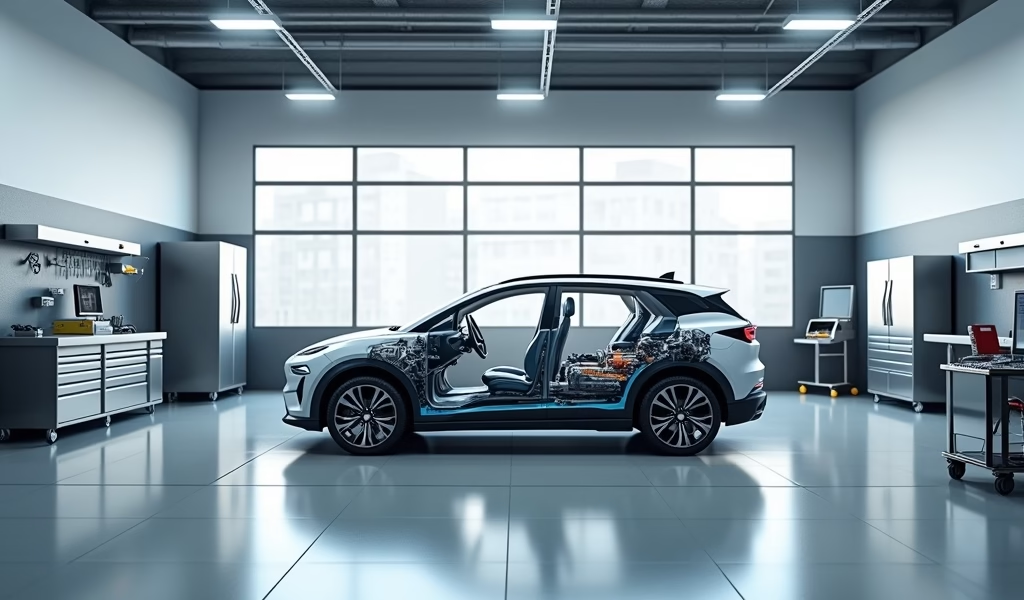
Understanding hybrid powertrains becomes easier when you know the key components involved. Let’s break down the essential parts that make these sophisticated systems work together seamlessly:
- Internal Combustion Engine (ICE): Usually smaller and more efficient than in conventional vehicles, the gas engine in hybrids is optimized to work with the electric components.
- Electric Motor/Generator: Converts electrical energy to mechanical motion during acceleration and reverses the process during deceleration, capturing energy through regenerative braking.
- Battery Pack: Stores electrical energy for use by the electric motor. Most modern hybrids use lithium-ion batteries, though some older models used nickel-metal hydride (NiMH).
- Power Split Device: In many hybrids, this ingenious component (often a planetary gear set) manages the flow of power between the engine, motor, and wheels.
- Power Control Unit: The brain of the system, this computer determines when to use the gas engine, electric motor, or both, optimizing for efficiency and performance.
The integration of these components creates a system that’s greater than the sum of its parts. I’ve worked on engines for decades, and the sophistication of modern hybrid powertrains still impresses me. For example, Toyota’s Hybrid Synergy Drive uses a complex power-split device that allows infinite variability in the ratio between the engine and motor, eliminating the need for a conventional transmission with fixed gear ratios.
Battery technology in particular has seen remarkable advancement. Early hybrids used batteries with limited capacity and power density. Today’s lithium-ion packs deliver significantly more energy while occupying less space and adding less weight. This evolution has enabled manufacturers to offer more electric range and better performance without compromising practicality.
Electric Vehicle Powertrains
Electric vehicle powertrains represent the ultimate simplification compared to internal combustion engines. While your traditional car engine might have hundreds of moving parts that need to work in precise harmony, an electric motor typically has just one moving component: the rotor. This fundamental difference leads to several distinct advantages in EVs.
The electric powertrain starts with energy stored in a high-voltage battery pack. When you press the accelerator, the vehicle’s power electronics control unit converts the battery’s DC (direct current) electricity into AC (alternating current) for the motor. The electric motor then converts this electrical energy into rotational force, which is transferred directly to the wheels, often through a single-speed transmission.
Unlike gasoline engines that need to build RPM to reach their power peak, electric motors deliver maximum torque instantly. This characteristic gives EVs their signature “instant response” when accelerating from a stop. It’s why even family-oriented EVs like the Hyundai Kona Electric can feel surprisingly sporty off the line.
Modern electric vehicles typically use one of three motor types:
- Permanent Magnet Motors: Compact, efficient, and powerful, these are the most common in passenger EVs but require rare earth elements
- Induction Motors: More durable and less expensive but slightly less efficient; popularized by Tesla in their earlier models
- Axial Flux Motors: An emerging technology offering greater power density and efficiency, though currently more expensive to produce
The simplicity of electric powertrains contributes to their reliability and longevity. With fewer moving parts, there’s simply less that can wear out or break down. According to Consumer Reports’ analysis, EV owners typically spend about half as much on maintenance and repairs compared to owners of gas-powered vehicles.
EV Battery Technology
The battery pack is the heart of any electric vehicle, effectively replacing the fuel tank of a conventional car. It’s also the most expensive component and the one that most directly influences an EV’s range, charging speed, and longevity. Let’s examine the technology that makes modern EVs practical for everyday use.
Today’s EVs predominantly use lithium-ion battery chemistry, similar to what’s in your smartphone but engineered specifically for automotive applications. These battery packs are actually composed of thousands of individual cells arranged in modules and managed by sophisticated battery management systems (BMS) that monitor temperature, voltage, and charge state of each section.
The energy density of EV batteries has improved dramatically. When I started working on the first mainstream hybrids 20 years ago, their battery systems were bulky and offered minimal range. Modern lithium-ion packs can store roughly four times more energy per pound. This advancement has enabled manufacturers to offer vehicles with 300+ miles of range while maintaining reasonable weight and interior space.
Battery technology continues evolving rapidly. Several promising developments are on the horizon:
- Solid-state batteries: Replacing liquid electrolytes with solid materials could offer greater energy density, faster charging, and improved safety
- Silicon anodes: Incorporating silicon can significantly increase energy capacity compared to current graphite anodes
- Lithium-sulfur chemistry: Potentially offering much higher energy density at lower cost, though cycle life remains challenging
Battery longevity has also exceeded many early predictions. Most manufacturers now warranty their EV batteries for 8-10 years or 100,000+ miles, and real-world data suggests many packs retain 80-90% of their original capacity even after a decade of use. This durability helps offset the initially higher purchase price through reduced operating costs over the vehicle’s lifetime.
Regenerative Braking
One of the most ingenious aspects of hybrid and electric powertrains is regenerative braking. This technology fundamentally changes how vehicles handle deceleration, turning what was once wasted energy into useful electricity. As a mechanic who’s worked on both conventional and electrified vehicles, I find this capability particularly impressive.
When you lift your foot off the accelerator or press the brake pedal in an EV or hybrid, the electric motor reverses its role, becoming a generator. The wheels’ kinetic energy turns the motor, generating electricity that’s fed back to the battery. This process simultaneously slows the vehicle and recaptures energy that would otherwise be lost as heat in traditional friction brakes.
The strength of regenerative braking varies between vehicles and can often be adjusted by the driver. Some EVs offer “one-pedal driving” where lifting off the accelerator provides enough regenerative braking to bring the vehicle to a complete stop without touching the brake pedal. This feature not only improves efficiency but can make city driving less fatiguing.
The efficiency gains from regenerative braking are substantial. In urban driving with frequent stops, regenerative systems can recapture 60-70% of the energy normally lost during braking. This contributes significantly to the overall efficiency advantage of electrified vehicles in city environments.
An additional benefit is reduced wear on traditional friction braking components. Many EV and hybrid owners report their brake pads lasting two to three times longer than in conventional vehicles because the physical brakes are used less frequently and less intensively. This translates to fewer maintenance visits and lower lifetime operating costs.
Efficiency and Performance
The efficiency advantages of hybrid and electric powertrains are striking when compared to conventional vehicles. Internal combustion engines typically convert only 20-30% of fuel energy into forward motion, with most energy lost as heat. In contrast, electric motors convert approximately 85-90% of electrical energy into mechanical force at the wheels.
This efficiency difference appears dramatically in the cost of operation. Even with regional variations in electricity and gasoline prices, EVs typically cost about one-third to one-half as much to “fuel” per mile compared to similar gas-powered vehicles. For many of my customers who’ve switched to electric vehicles, this reduced operating cost is one of the most immediately noticeable benefits.
Performance characteristics also differ significantly between powertrain types. Electric motors deliver their maximum torque from zero RPM, providing immediate response when accelerating. This characteristic gives even modestly-powered EVs a sporty feel in everyday driving situations like merging onto highways or passing other vehicles.
Hybrids offer their own performance advantages. By combining electric and combustion power sources, they can provide more total system horsepower than would be practical with either system alone. The electric motor’s instant torque complements the combustion engine’s sustained power output, creating a responsive driving experience across all speed ranges.
The distribution of weight in electrified vehicles also influences handling. Battery packs are typically mounted low in the vehicle structure, creating a lower center of gravity than most conventional vehicles. This configuration often improves cornering stability and can make the vehicle feel more planted on the road – a characteristic that surprises many first-time EV drivers.
Maintenance Considerations
As someone who’s spent decades working on all types of vehicles, I can tell you that maintenance requirements differ significantly between conventional, hybrid, and electric powertrains. These differences affect both the frequency of service visits and the types of work required.
Fully electric vehicles eliminate many traditional maintenance items entirely. There’s no engine oil to change, no timing belts to replace, no fuel filters, spark plugs, or exhaust systems to service. Even brake maintenance is reduced thanks to regenerative braking. EV maintenance primarily focuses on tires, cabin air filters, battery health monitoring, and cooling system checks.
Hybrids fall somewhere in between. They still require engine oil changes, though often at extended intervals due to less frequent engine operation. Other traditional services like spark plug replacement remain necessary but may be needed less frequently than in conventional vehicles. Hybrid-specific components like the high-voltage battery typically require little maintenance beyond periodic system checks.
Here’s a quick comparison of typical maintenance schedules:
- Conventional Vehicle: Oil changes every 5,000-10,000 miles, transmission service at 60,000-100,000 miles, spark plugs at 60,000-100,000 miles, timing belt at 60,000-100,000 miles (if equipped)
- Hybrid Vehicle: Oil changes every 5,000-10,000 miles (some extend to 15,000 miles), hybrid system check annually, similar schedules for other engine components but with potential for extended intervals
- Electric Vehicle: Annual inspection, cabin air filter every 2-3 years, coolant system service every 100,000+ miles, brake fluid service every 2-5 years
The specialized nature of electrified powertrains does mean that when service is required, it should be performed by technicians with proper training and equipment. High-voltage systems in both hybrids and EVs require specific safety protocols and diagnostic approaches. Most manufacturers provide specialized training for their dealership technicians, and increasingly, independent shops like mine are investing in the training and equipment needed to properly service these vehicles.
Future of Electrified Powertrains
The technology powering hybrid and electric vehicles is evolving rapidly. Having watched this industry develop over decades, I’m confident we’re just seeing the beginning of what’s possible with electrified powertrains. Several exciting trends point to where the technology is headed.
Battery advancements continue at a remarkable pace. Solid-state batteries, which replace liquid electrolytes with solid materials, promise greater energy density, faster charging, and improved safety. Major automakers and startups alike are racing to commercialize this technology within the next 5-10 years. When successful, we could see EVs with 500+ mile ranges that charge in just 10-15 minutes.
Motor technology is also advancing. Newer designs like axial flux motors offer greater power density and efficiency compared to traditional radial motors. Some manufacturers are also developing motors that reduce or eliminate rare earth materials, addressing both cost and supply chain concerns while maintaining performance.
Charging infrastructure continues to expand globally, with particular focus on ultra-fast DC charging for longer trips. Meanwhile, bidirectional charging capabilities are opening new possibilities for vehicle-to-grid and vehicle-to-home energy systems, where your car can actually power your home during outages or help balance the electrical grid.
Perhaps most interesting is the integration of advanced software with electrified powertrains. Modern EVs and hybrids increasingly leverage artificial intelligence to predict energy needs based on route, traffic, and even driver behavior patterns. These systems can optimize power usage in ways that weren’t possible with mechanical-only controls, continuously improving efficiency through over-the-air updates.
As a mechanic who’s embraced these technologies, I’m excited about their potential while recognizing there’s still a place for different powertrain types depending on specific needs. The future will likely feature a diverse mix of vehicles, with battery-electric models becoming increasingly dominant in personal transportation while hybrids and other alternative technologies serve specialized applications.
Conclusion
Understanding How Hybrid and Electric Powertrains Work reveals a fascinating convergence of mechanical engineering, electrical systems, and computer control that’s revolutionizing transportation. These technologies represent not just incremental improvements but a fundamental rethinking of how vehicles convert and utilize energy.
Throughout this guide, we’ve explored the key differences between conventional, hybrid, and fully electric powertrains. We’ve examined how components like motors, batteries, and regenerative braking systems work together to deliver improved efficiency and performance while reducing environmental impact. We’ve also considered practical aspects like maintenance needs and the evolving landscape of electrified vehicle technology.
As these powertrains continue to evolve, they’re becoming increasingly accessible and practical for everyday drivers. The early concerns about range, charging infrastructure, and longevity are being addressed through continuous innovation and real-world experience. For many drivers, the benefits of lower operating costs, reduced maintenance, and responsive performance make the switch to an electrified vehicle increasingly compelling.
Whether you’re considering your first hybrid or electric vehicle or simply curious about how these technologies work, I hope this guide has provided valuable insights from someone who’s spent decades working with all types of powertrains. The automotive landscape is changing rapidly, but with understanding comes confidence – both for those driving these vehicles and for professionals like me who service them.
Frequently Asked Questions
How long do hybrid and electric vehicle batteries last?
Most modern EV and hybrid batteries are designed to last 8-10 years or 100,000+ miles. Real-world data shows many retaining 80-90% of original capacity even after a decade of use.
Are electric vehicles more expensive to repair than conventional cars?
EVs typically cost 30-50% less in maintenance over their lifetime compared to conventional vehicles. They have fewer moving parts and systems that can fail, though specialized repairs may require technicians with specific training.
How far can electric vehicles drive on a single charge?
Modern electric vehicles offer ranges from approximately 150 miles for entry-level models to over 350 miles for premium options. Range continues to improve with each new generation of battery technology.
Do hybrid vehicles need to be plugged in?
Standard hybrids don’t require plugging in as they generate electricity through regenerative braking and the engine. Only plug-in hybrids (PHEVs) offer the option to charge from an external power source.
What happens if an electric vehicle runs out of charge?
When an EV’s battery is depleted, the vehicle will stop operating just like a conventional car without fuel. Most modern EVs provide ample warnings and navigation to charging stations to prevent this situation.
Pingback: BMW Hybrid Cars: 5 Essential Maintenance Tips for Longevity - knowsyourcar.com