
Overview
Like dating someone high-maintenance but irresistible, owning a Range Rover Evoque requires understanding its common issues—particularly with the transmission, electrical system, suspension, and engine—and implementing a proactive maintenance strategy to prevent costly repairs. With proper care including following a stricter-than-recommended maintenance schedule, selecting the right service providers, and addressing minor problems early, your luxury SUV can deliver 150,000-200,000 miles of that signature Range Rover experience without breaking the bank.
Table of Contents
- Understanding Your Range Rover Evoque
- Common Range Rover Evoque Problems and How to Prevent Them
- Transmission Issues: The Evoque’s Achilles Heel
- Electrical System: Managing Complex Electronics
- Suspension and Steering: Maintaining That Signature Ride
- Engine and Cooling System: Preventative Care
- Creating a Bulletproof Maintenance Schedule
- Smart Cost Management for Evoque Owners
- DIY vs. Professional Maintenance: Finding the Right Balance
- Avoiding Common Maintenance Mistakes
- Extending Your Evoque’s Lifespan
- Conclusion: Protecting Your Luxury Investment
- Frequently Asked Questions
When you slide behind the wheel of a Range Rover Evoque, you’re experiencing automotive luxury at its finest. That distinctive silhouette, sophisticated interior, and capable performance make it a standout in the compact luxury SUV segment. But as a mechanic who’s spent years working on these beautiful machines, I’ve seen how quickly that ownership joy can turn to frustration when faced with unexpected repair bills.
The truth is, while Land Rover has made significant reliability improvements in recent years, the Evoque remains a complex vehicle with maintenance requirements that can catch owners off guard. With repair costs easily climbing above $1,500 for moderate issues, knowing how to prevent problems isn’t just about maintaining performance—it’s about protecting your wallet.
The good news? Most costly Evoque repairs are completely preventable with the right approach to maintenance and care. In this guide, I’ll walk you through everything you need to know to keep your stylish SUV running smoothly and avoid those painful repair bills.
Understanding Your Range Rover Evoque
Before diving into specific maintenance tips, it helps to understand what makes your Evoque tick. At its heart, most models feature either the Ford EcoBoost-derived 2.0L turbocharged engine (in earlier models) or JLR’s own Ingenium 2.0L engine (in models from 2018 onward). These powerplants connect to either the ZF 9-speed automatic (which has had its share of troubles) or the more reliable ZF 8-speed found in newer versions.
Your Evoque’s sophistication extends well beyond its powertrain. The all-wheel-drive system, multi-link suspension, terrain response system, and network of electronic control units all contribute to its premium driving experience—but also add complexity when things go wrong.
Different model years have their own quirks:
- 2012-2014 models often struggle with early production issues, infotainment glitches, and transmission troubles
- 2015-2017 models show improved reliability but watch for electrical gremlins and oil consumption
- 2018-2019 first-generation models are better overall but monitor for coolant leaks
- 2020-present second-generation models have significantly improved reliability
Unlike its larger siblings, the Evoque doesn’t use air suspension, which eliminates one potential headache. However, its compact packaging makes some repairs more labor-intensive, as components are tightly packed and may require additional disassembly to access.
Common Range Rover Evoque Problems and How to Prevent Them
After working on hundreds of Evoques, I’ve identified clear patterns in what tends to fail and—more importantly—how to prevent those failures. Let’s tackle the most common issues one by one, starting with the component that causes the most headaches.
Transmission Issues: The Evoque’s Achilles Heel
The transmission, particularly the ZF 9-speed automatic, has been a persistent trouble spot for the Evoque. In my workshop, I’ve seen owners arrive concerned about hesitation between gears, jerky downshifts, unusual vibrations, warning lights, and delays when shifting from park to drive.
The 9-speed’s complex design, with its numerous clutch packs and sophisticated electronic controls, makes it particularly vulnerable to both mechanical and electronic failures. Many owners have experienced improved performance after software updates, which points to the electronic complexity at work.
To help your transmission live a long, healthy life:
- Always allow the vehicle to warm up before aggressive driving (I can’t stress this enough)
- Change transmission fluid every 30,000 miles—not the 60,000 Land Rover recommends
- Use only the specified transmission fluid—substitutes can cause catastrophic damage
- Have transmission software updates performed promptly when available
- Respect towing capacity limits to avoid overstressing components
With proper care, an Evoque transmission should last 120,000-150,000 miles. A transmission fluid service costs around $300-400 but could save you thousands in repairs down the road. This is especially important when considering your vehicle’s transfer case maintenance, as the two systems work in tandem.
Electrical System: Managing Complex Electronics
The Evoque’s electrical system is both sophisticated and occasionally temperamental. I regularly see issues including infotainment freezes, touchscreen failures, intermittent sensor malfunctions, power accessory problems, and battery drain.
Early warning signs to watch for include dimming headlights, sluggish power windows, infotainment glitches, or warning messages that appear and vanish seemingly at random. These symptoms often indicate developing problems that will worsen over time.
The Evoque’s battery faces significant demands from numerous control modules that remain partially active even when the vehicle is off. To maintain electrical system health:
- Drive the vehicle regularly for at least 30 minutes to ensure complete battery charging
- Use a trickle charger for vehicles that sit for extended periods
- Keep battery terminals clean and connections tight
- Have the battery and charging system tested annually
- Ensure software updates are performed during regular service
The sensitive electronics in your Evoque can also be damaged during improper jump starts or by power surges. Always follow correct jump-starting procedures and consider using a surge protector if charging at home. According to J.D. Power research, parasitic drain is a leading cause of premature battery failure in luxury vehicles.
Suspension and Steering: Maintaining That Signature Ride
The Evoque’s sporty handling comes from a sophisticated suspension system that requires vigilant maintenance. In my experience, common issues include worn control arm bushings, strut failures, and steering rack problems.
Pay attention to knocking sounds when driving over bumps, unusual vibrations through the steering wheel, or a feeling that the vehicle “wanders” on the highway. These symptoms often indicate developing suspension issues that will only get worse—and more expensive—if ignored.
While standard Evoques don’t have the air suspension of larger Range Rovers, they still feature complex suspension geometry. Prevention measures include:
- Regular inspection of rubber bushings and ball joints for wear
- Alignment checks after driving in rough conditions or hitting significant potholes
- Rotating tires every 5,000 miles to ensure even wear
- Prompt replacement of worn shock absorbers to prevent strain on other components
I recommend establishing a proactive suspension check schedule: inspect visually at every oil change and have a comprehensive suspension evaluation annually or every 15,000 miles. Catching a $200 control arm bushing problem early can prevent a $1,500 steering rack replacement later. This approach dovetails nicely with your differential service schedule, which is another critical maintenance area.
Engine and Cooling System: Preventative Care
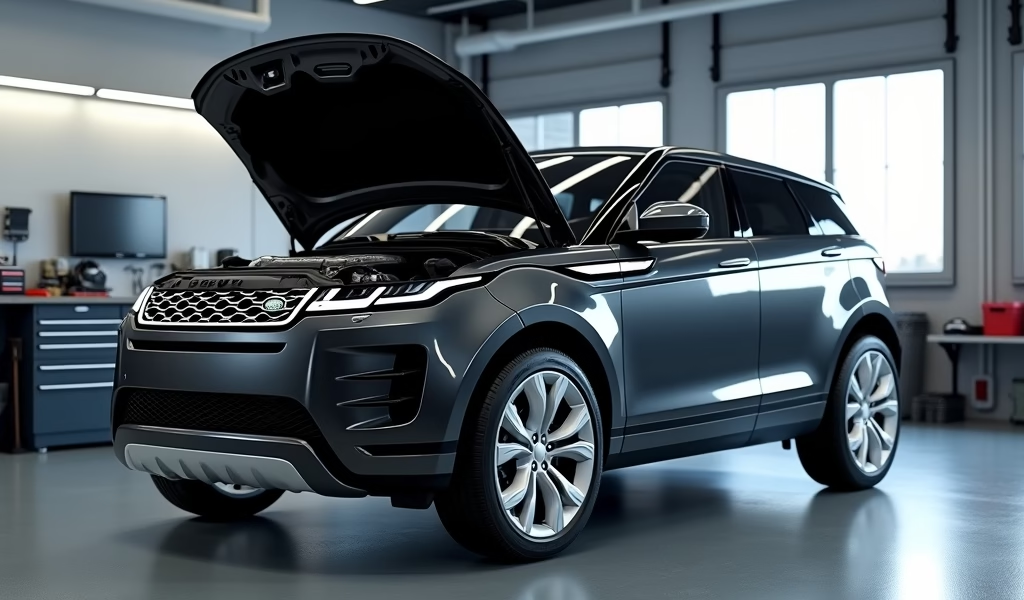
Evoque engines generally prove reliable when maintained properly, but several common issues demand attention. The Ingenium engines can consume oil at rates higher than expected—I’ve had customers report adding a quart every 1,000-1,500 miles. Monitoring oil level is critical, as running low can cause catastrophic engine damage.
Coolant leaks often develop around water pumps and thermostat housings. Watch for sweet-smelling fluid under the vehicle, temperature gauge fluctuations, or low coolant warnings. The cooling system operates under high pressure, and small leaks can quickly become major problems if ignored.
For engine longevity, I advise my customers to:
- Change oil every 5,000 miles using only manufacturer-specified synthetic oil
- Replace the air filter more frequently if driving in dusty conditions
- Follow the timing belt replacement schedule precisely (typically 70,000-85,000 miles depending on model year)
- Have coolant flushed and replaced every 40,000 miles
- Use fuel system cleaners quarterly to prevent injector deposits
These engines respond well to preventative maintenance but punish neglect severely. A $150 cooling system pressure test could save you from a $4,000+ engine replacement. Setting up regular oil change reminders is one of the simplest ways to protect your engine investment.
Creating a Bulletproof Maintenance Schedule
Land Rover’s recommended service intervals provide a baseline, but real-world Evoque ownership demands more attention. Based on my experience, here’s a customized maintenance schedule that accounts for the vehicle’s specific needs:
- Every 5,000 miles: Oil change, fluid level checks, and visual inspection
- 15,000 miles: Comprehensive inspection, oil change, cabin and engine air filters
- 30,000 miles: Transmission fluid change, brake fluid flush, fuel filter replacement
- 45,000 miles: Differential fluid change, suspension inspection, coolant check
- 60,000 miles: Major service including all fluids, filters, and inspections
- 70,000-85,000 miles: Timing belt replacement for applicable models
Seasonal maintenance matters too. Before winter, ensure your battery is strong and coolant has adequate freeze protection. Before summer, verify cooling system integrity and air conditioning performance. I’ve seen too many Evoques suffer preventable failures due to seasonal neglect.
Digital maintenance tracking apps like GOFAR, aCar, or even the notes app on your phone can help document service history, track expenses, and set reminders for upcoming maintenance. Detailed records also significantly enhance resale value when it’s time to move on to your next vehicle.
Smart Cost Management for Evoque Owners
From my years in the shop, I’ve observed that ownership costs increase predictably with vehicle age. Expect annual maintenance costs in these ballparks:
- 0-3 years: $800-1,200
- 4-6 years: $1,200-2,000
- 7+ years: $2,000-3,500+
Extended warranties merit serious consideration for Evoque owners. Factory-backed extended coverage typically costs $2,500-4,000 but can save substantially on major repairs. Third-party warranties can be less expensive but verify coverage carefully—many exclude electronic components or have high deductibles that reduce their value.
The dealership versus independent specialist question comes up with nearly every customer I advise. For under-warranty vehicles, dealership service preserves coverage and ensures proper documentation. For older Evoques, specialized independent shops often provide equivalent service at 30-40% lower costs. Research independents carefully, ensuring they have specific Land Rover expertise and proper diagnostic equipment.
Parts selection requires strategic thinking. Always use OEM (or high-quality equivalent) for:
- All electronic components
- Suspension parts
- Braking system components
- Anything related to safety systems
You can often save with carefully selected aftermarket options for:
- Filters
- Brake pads (though use OEM rotors)
- Basic maintenance items like spark plugs and wiper blades
DIY vs. Professional Maintenance: Finding the Right Balance
Even if you’re not mechanically inclined, you can handle some basic Evoque maintenance tasks that save money and keep your vehicle in top condition. DIY-friendly tasks include:
- Air filter replacements
- Wiper blade changes
- Battery checks and cleaning
- Fluid level inspections
- Tire pressure monitoring
- Basic exterior and interior maintenance
However, the Evoque’s complex systems require specific diagnostic tools for many repairs. Land Rover-specific scan tools like IDS, SDD, or JLR Pathfinder are essential for properly diagnosing electronic issues. These specialized tools typically cost thousands, placing them beyond the reach of most DIYers.
Professional diagnosis becomes non-negotiable when dealing with:
- Check engine lights
- Transmission behavior issues
- Electrical problems
- Suspension noises
- Any safety-related concerns
Finding a qualified Land Rover specialist means looking beyond generic repair shops. Seek technicians with specific Land Rover training, preferably with Master Technician certification. Online forums like Range Rovers Connect or Land Rover Forums can help identify respected specialists in your area.
Avoiding Common Maintenance Mistakes
From my years working with Evoque owners, I’ve noticed several recurring mistakes that lead to preventable repairs:
Ignoring early warning signs tops the list. That subtle vibration from a failing wheel bearing or occasional transmission hesitation might seem minor, but addressing these symptoms early typically costs a fraction of waiting until complete failure occurs.
Using incorrect fluids ranks among the most destructive mistakes I see. The Evoque’s sophisticated systems require specific fluid specifications:
- Transmission fluid must match the exact specification
- Engine oil must meet JLR’s standards
- Power steering fluid cannot be substituted with generic alternatives
- Brake fluid must meet the proper DOT classification
After certain repairs, electronic calibrations are essential but often overlooked by inexperienced technicians. Components like steering angles, battery replacements, and even tire pressure sensors require system resets to function properly.
Perhaps most critically, many owners neglect software updates. The Evoque relies on dozens of electronic control modules, and manufacturer software updates often resolve driveability issues, improve efficiency, and prevent component failures.
Extending Your Evoque’s Lifespan
Your driving habits significantly impact your Evoque’s longevity. After seeing hundreds of these vehicles in various conditions, I strongly recommend:
- Allowing proper warm-up time, especially in cold weather
- Avoiding aggressive acceleration until operating temperature is reached
- Using engine braking on descents rather than riding the brakes
- Shifting to neutral when stopped for extended periods
Environmental factors affect durability too. Store your Evoque in a garage when possible, and if outdoor storage is necessary, consider a high-quality car cover. In coastal areas, regular underbody cleaning prevents corrosion from road salt or sea air.
Strategic upgrades can improve reliability. Consider:
- Higher-capacity cooling systems for hot climates
- Enhanced air filtration in dusty environments
- Oil catch cans to reduce carbon buildup (particularly beneficial for direct-injection engines)
Meticulous documentation proves invaluable both for your maintenance planning and eventual resale. Keep all service records, parts receipts, and repair documentation organized, whether physically or digitally. According to Consumer Reports, well-documented maintenance can increase resale value by as much as 10%.
Conclusion: Protecting Your Luxury Investment
The Range Rover Evoque delivers a driving experience few competitors can match, combining distinctive styling, luxurious accommodations, and genuine capability in a compact package. By understanding common failure points, establishing a proactive maintenance routine, and addressing minor issues before they escalate, you can enjoy your Evoque’s premium qualities without dreading unexpected repair bills.
The financial benefits of preventative maintenance become clear when comparing the $2,000-3,000 annual cost of thorough maintenance against the potential $5,000-10,000 expense of major repair work. Beyond cost savings, proper care ensures your vehicle delivers the performance, comfort, and reliability you expected when you purchased it.
Building a relationship with a qualified service provider—whether a dealership or specialized independent shop—proves invaluable. The technician who knows your vehicle’s history can often spot developing issues before they trigger warning lights or symptoms you’d notice.
Your Range Rover Evoque isn’t just transportation; it’s an expression of your appreciation for fine engineering and luxury. With thoughtful maintenance, it can remain both reliable and rewarding for many years to come.
Frequently Asked Questions
How reliable is the Range Rover Evoque compared to other luxury SUVs?
The Evoque ranks slightly below average in reliability compared to competitors like the Audi Q5 and BMW X3. Models from 2018 onward show significant improvement in reliability metrics.
What is the average lifespan of a Range Rover Evoque?
With proper maintenance, an Evoque can last 150,000-200,000 miles. Vehicles that receive regular preventative maintenance consistently reach higher mileage milestones.
How much should I budget annually for Evoque maintenance?
Budget approximately $1,200-1,500 annually for maintenance on a newer Evoque and $2,000-3,000 for models over 5 years old. This includes regular services and setting aside funds for eventual larger repairs.
Is the Evoque expensive to repair compared to other SUVs?
Yes, the Evoque is more expensive to repair than mainstream SUVs and slightly above average compared to other luxury models. Parts costs and specialized labor requirements contribute to higher repair expenses.
Should I buy an extended warranty for my Evoque?
An extended warranty is worth considering, especially for models with the 9-speed transmission or if you plan to keep the vehicle beyond the factory warranty period. Choose a factory-backed option when possible for the most comprehensive coverage.